Many global cities are investing in cycle infrastructure to help create more sustainable and healthy communities. Currently cycling levels and infrastructure quality are highly varied across European cities, and planners and researchers need methods to track progress towards achieving high-quality, safe cycle networks. This blog post describes research on ENHANCE, a Driving Urban Transitions project, quantifying cycle network quality using the examples of Amsterdam, a leading cycling city, and London, a city seeking to improve its cycling infrastructure.
Classifying Cycle Infrastructure Quality Two frameworks are used here to classify cycle infrastructure quality. The first analyses the geography of cycle lanes, with protected lanes physically separated from traffic being the desired standard to enable all residents to use the cycle network, including more vulnerable cyclists such as children and elderly residents. The second approach is a modified version of Level of Traffic Stress framework which measures wider road conditions in addition to cycle lanes, such as speed limits, road type and road width (the full methodology is described here). The data used is OpenStreetMap which includes comprehensive data on cycle lanes and streets as well as being a global dataset, enabling international comparisons.
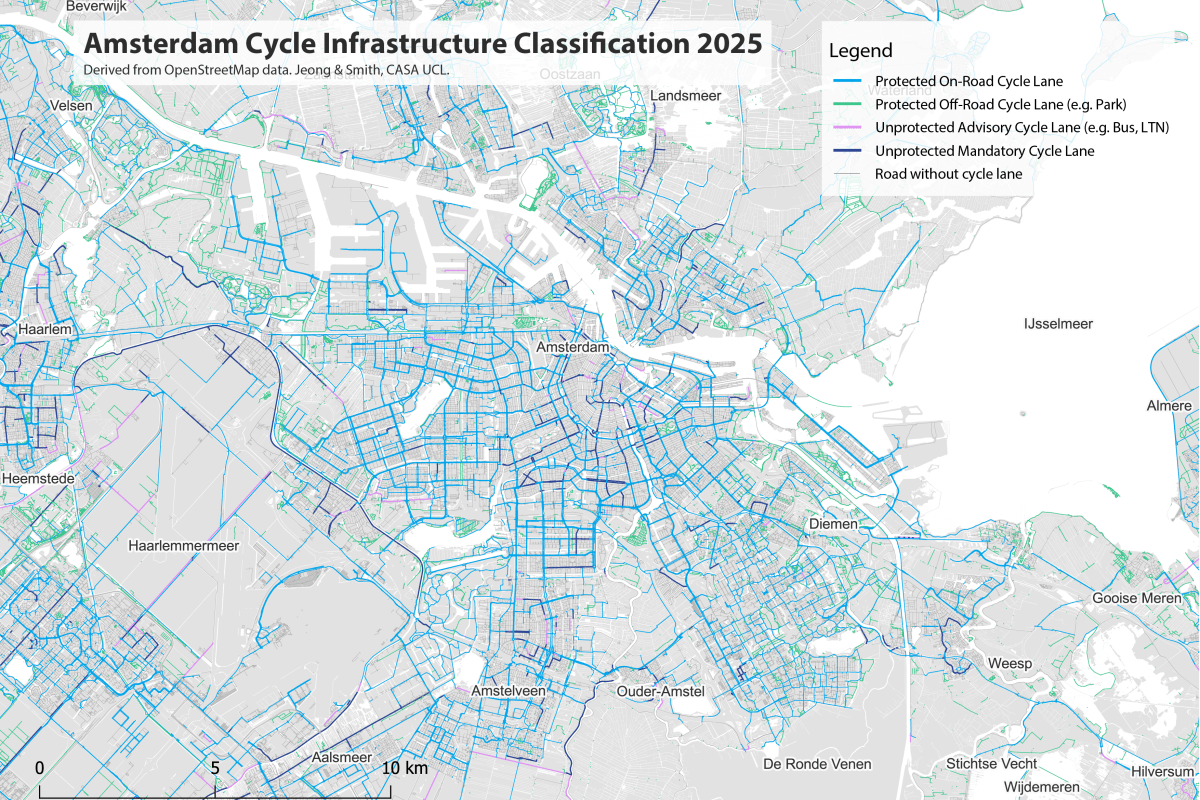
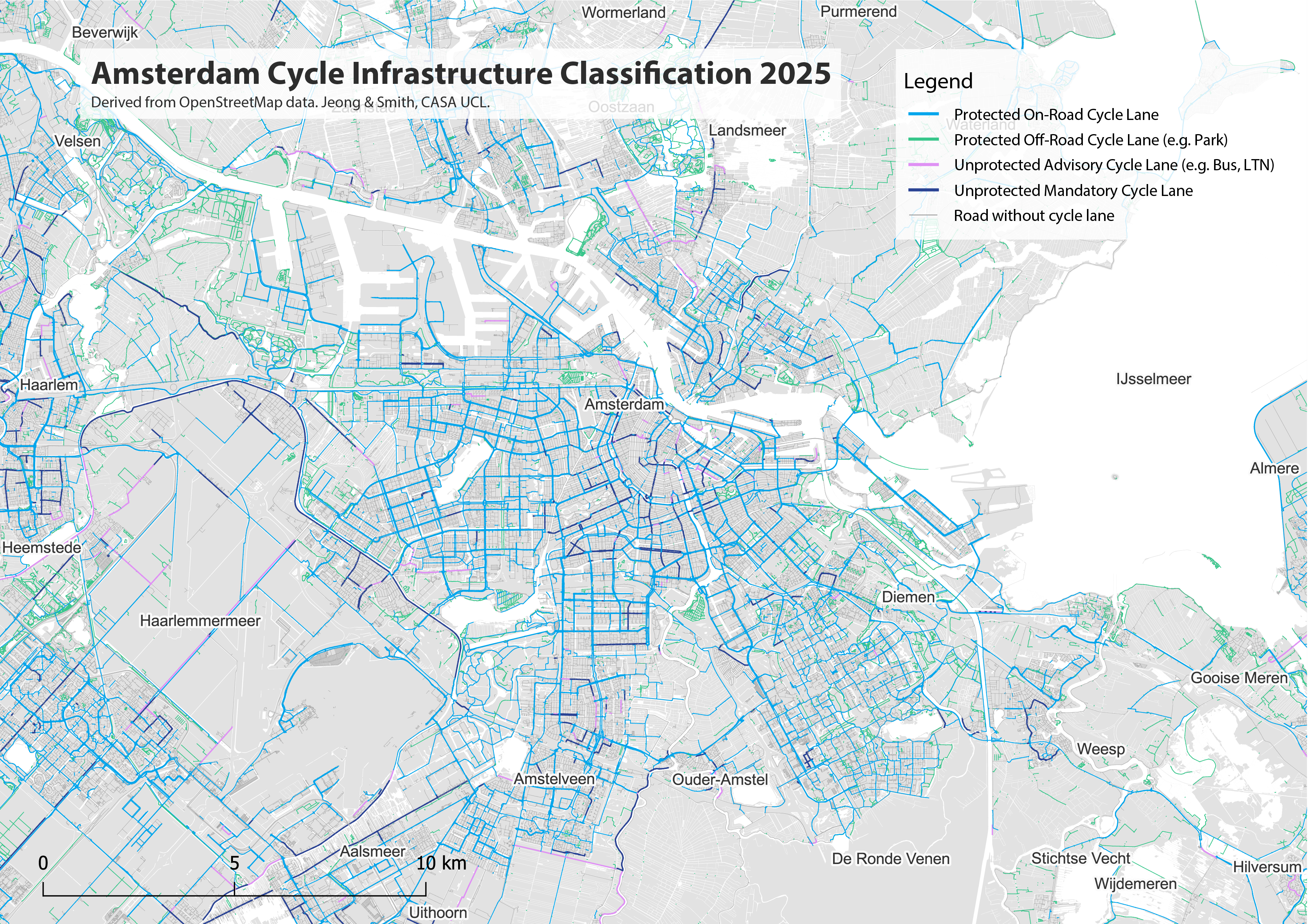
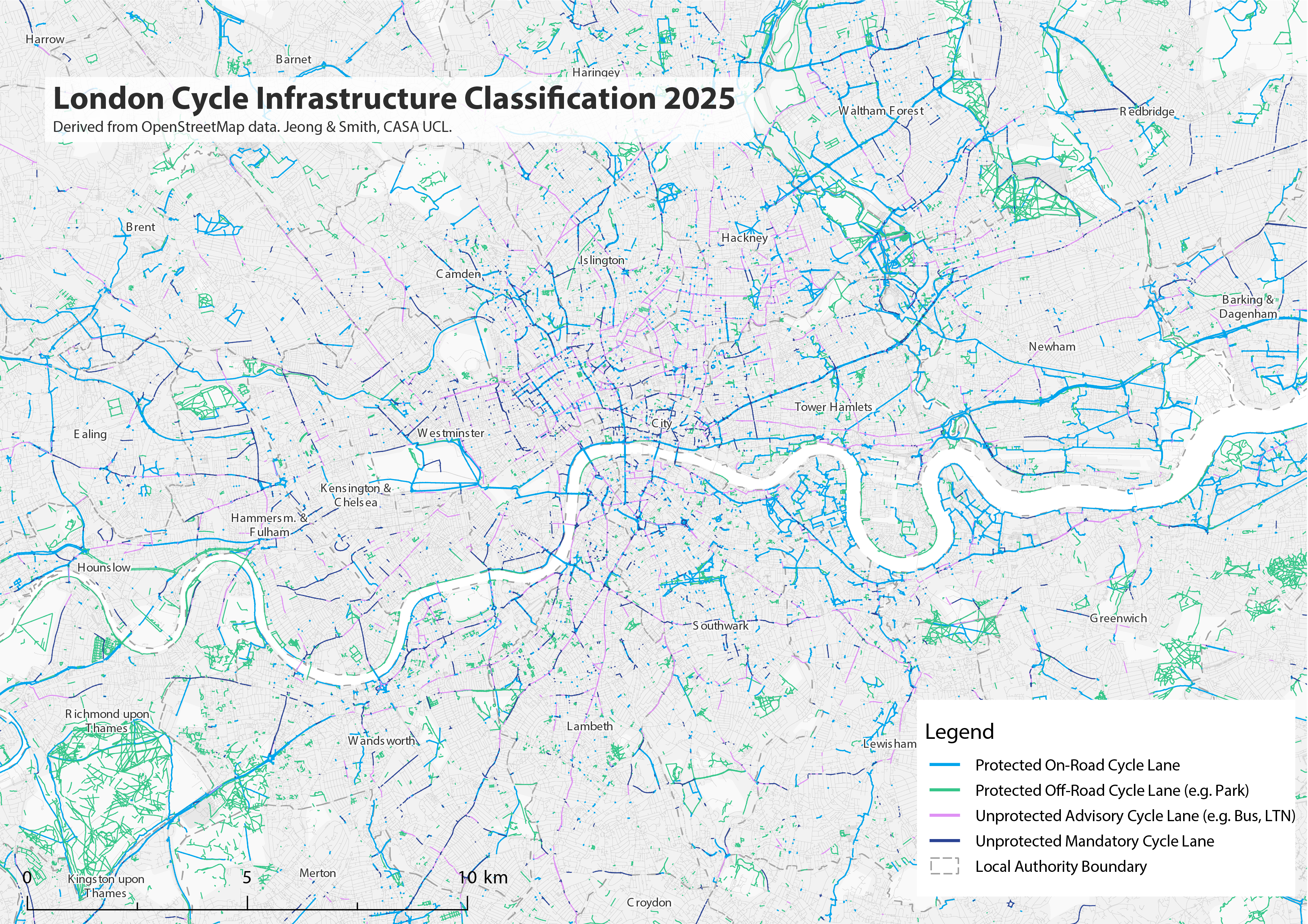
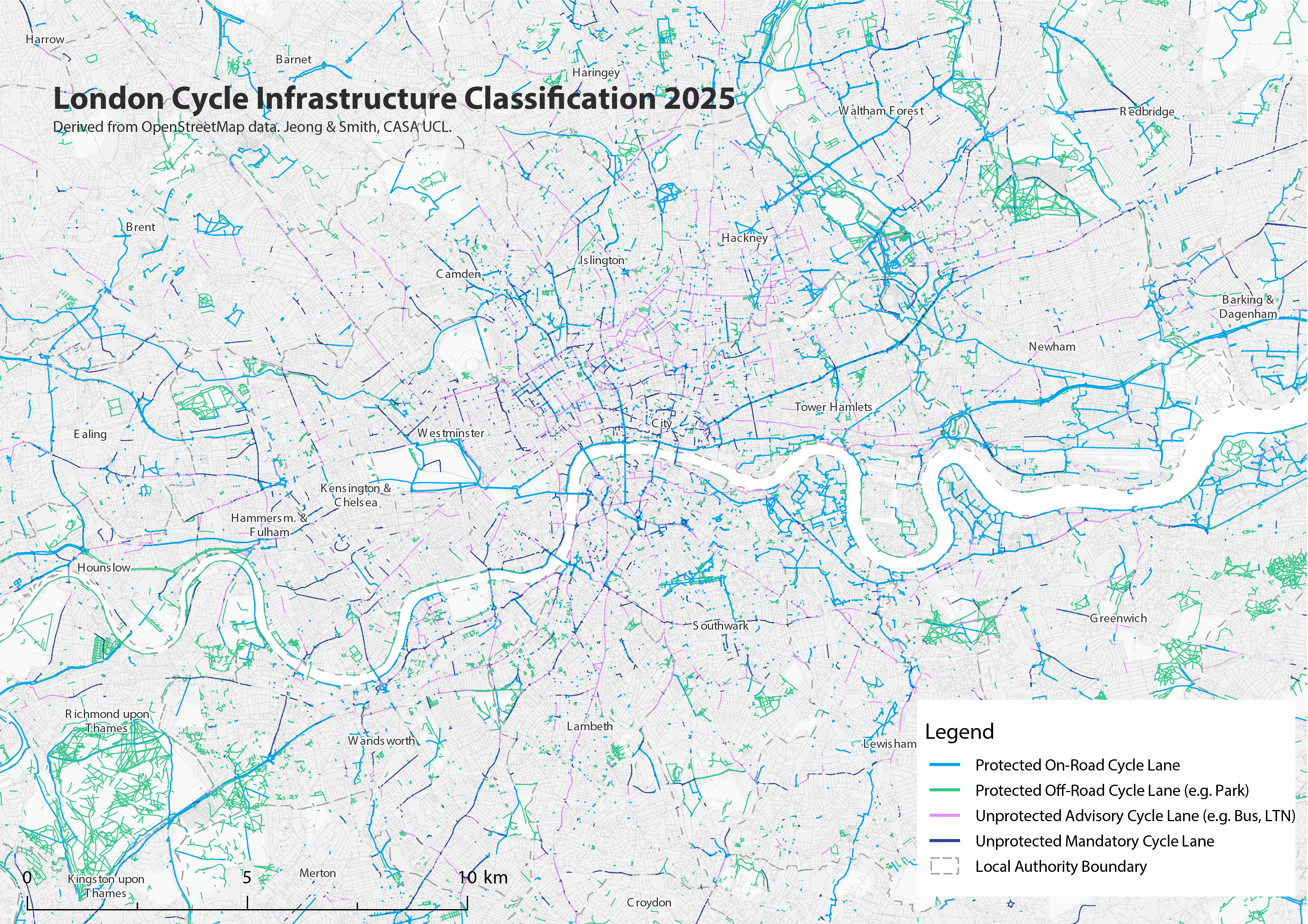
The maps below show the classification of cycle infrastructure for the Amsterdam region and for Greater London. The bright blue and bright green routes indicate high-quality protected cycle infrastructure separated from traffic. Amsterdam has a very comprehensive cycling network, covering all main roads, and linking urban settlements across the wider region. Green colours represent off-road cycle lanes in parks and rural areas. London’s network is in comparison patchy and incomplete, with large areas of the city lacking cycle infrastructure. The purple and dark blue lines indicate unprotected cycle infrastructure, such as Low Traffic Neighbourhoods where cyclists mix with low speed traffic (purple), or on-road cycle lanes without a physical barrier with road traffic (dark blue). These unprotected cycle lanes are rare in Amsterdam and relatively common in London. Roads without any cycle lane infrastructure are shown in grey (note this can also reflect data missing in the OpenStreetMap database).
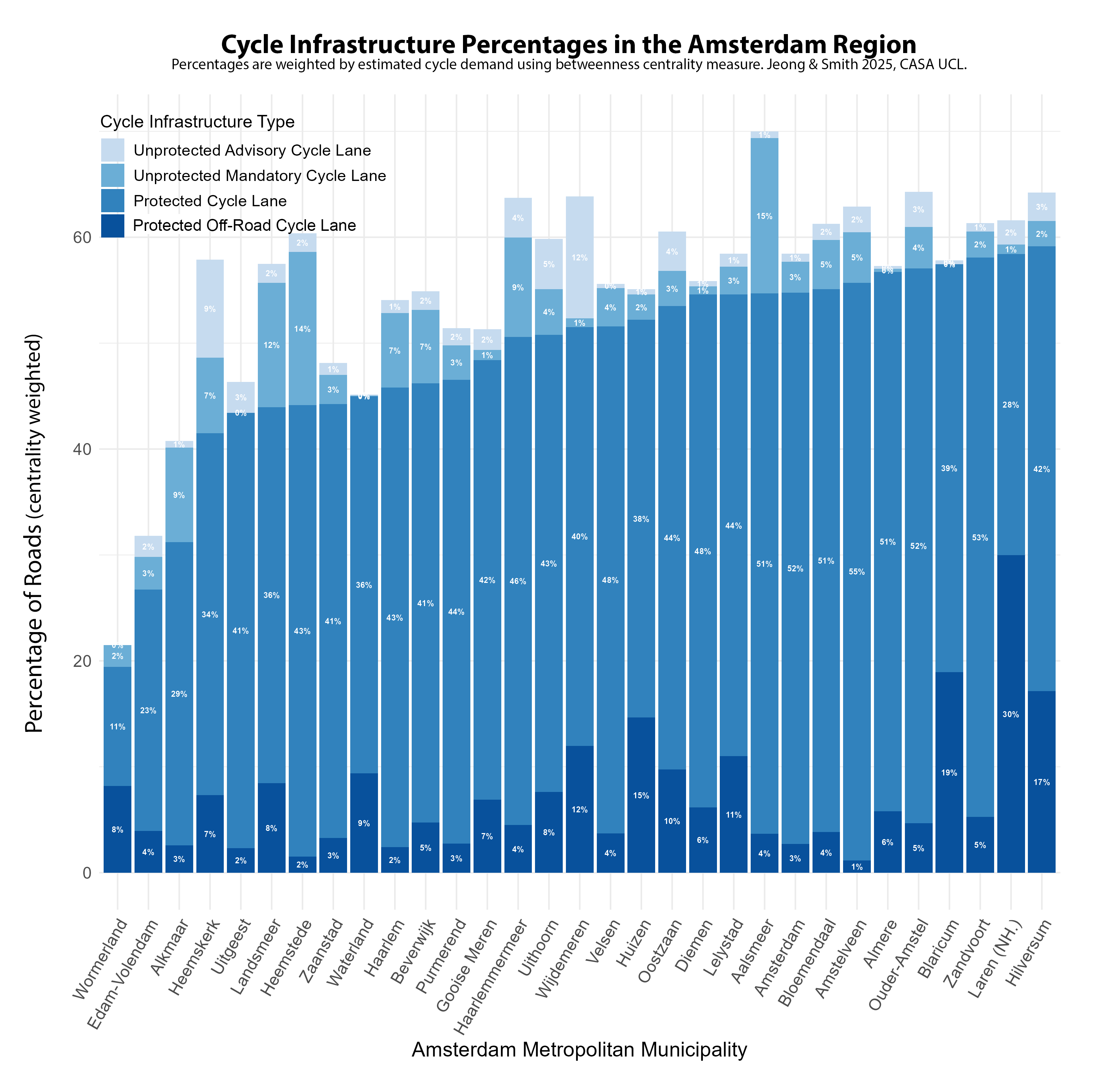
As well as mapping cycle infrastructure quality, the classification measure can also be used for statistical summaries. The chart below shows the percentage of roads with different types of cycle infrastructure, summed for each local authority in the Amsterdam region. This measure takes into account cycle route demand, based on network analysis to the most common destinations. This means that popular major cycle routes are weighted highly compared to sparse rural routes (the results are then normalised for each authority). In the Amsterdam region, most authorities have over half of all roads with protected cycle lanes. For the City of Amsterdam, the figure is 55% and there are eight authorities that score even more highly than Amsterdam with this measure, led by Hilversum and Laren. The comprehensive protected network is consistent across the metropolitan region, with only Wormerland, Edam-Volendam and Alkmaar falling below 40%. These authorities are all in the more rural Noord-Holland peninsula.
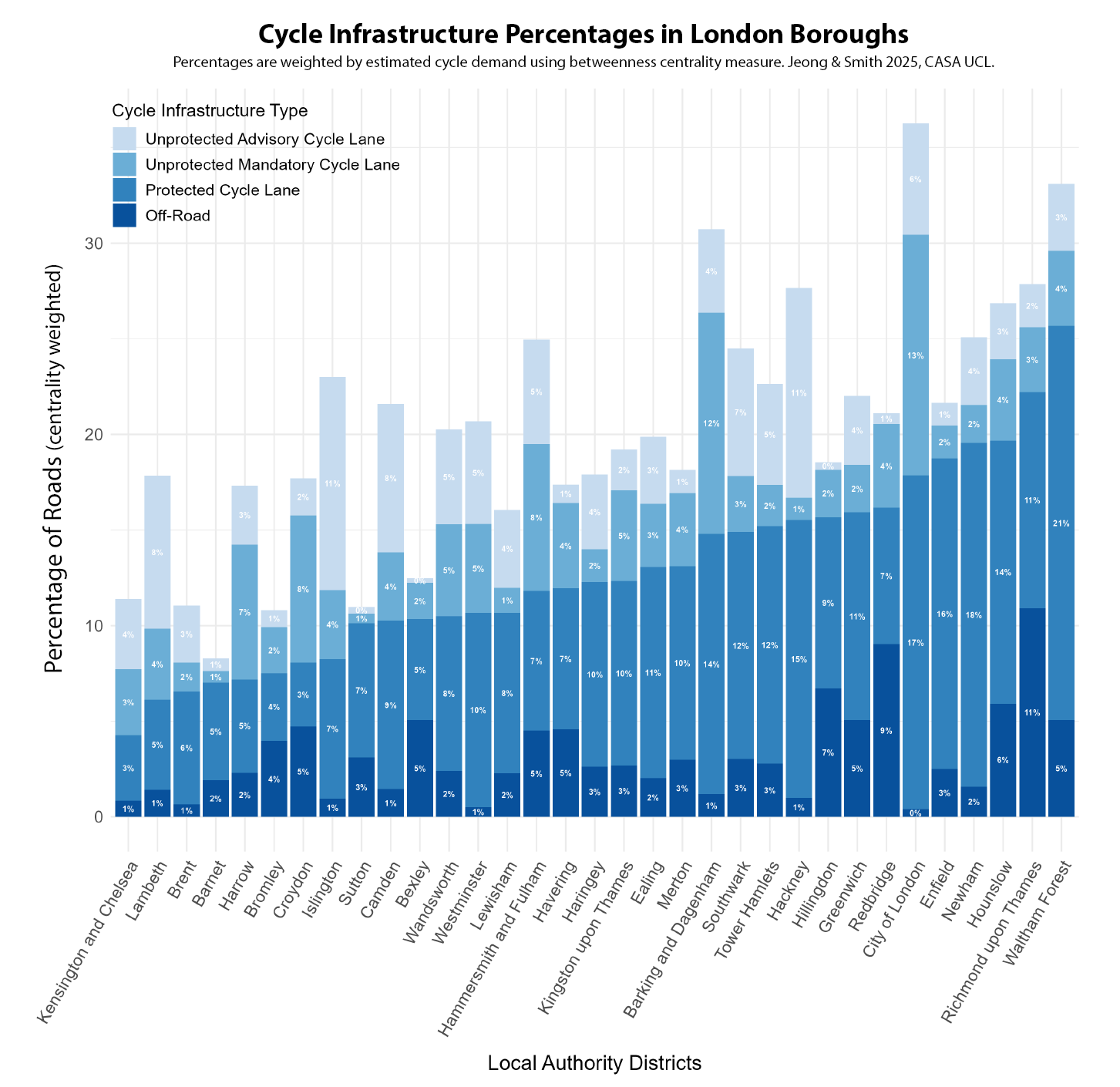
In London, the equivalent percentage of protected cycle lanes is around a third of the levels in Amsterdam, generally falling between 10-20% for most London boroughs. There is a wider variation between authorities, and a much higher percentage of lower quality unprotected cycle lanes as well. This outcome is the result of both a general lack of investment in cycling over decades, and the lack of a city-wide cycling strategy (London’s earliest was in 2013), leading to boroughs pursuing independent policies. There is evidently a huge gap with Amsterdam. Only two London boroughs, Waltham Forest and Richmond, can come close to the worse performing authorities in the Amsterdam region.
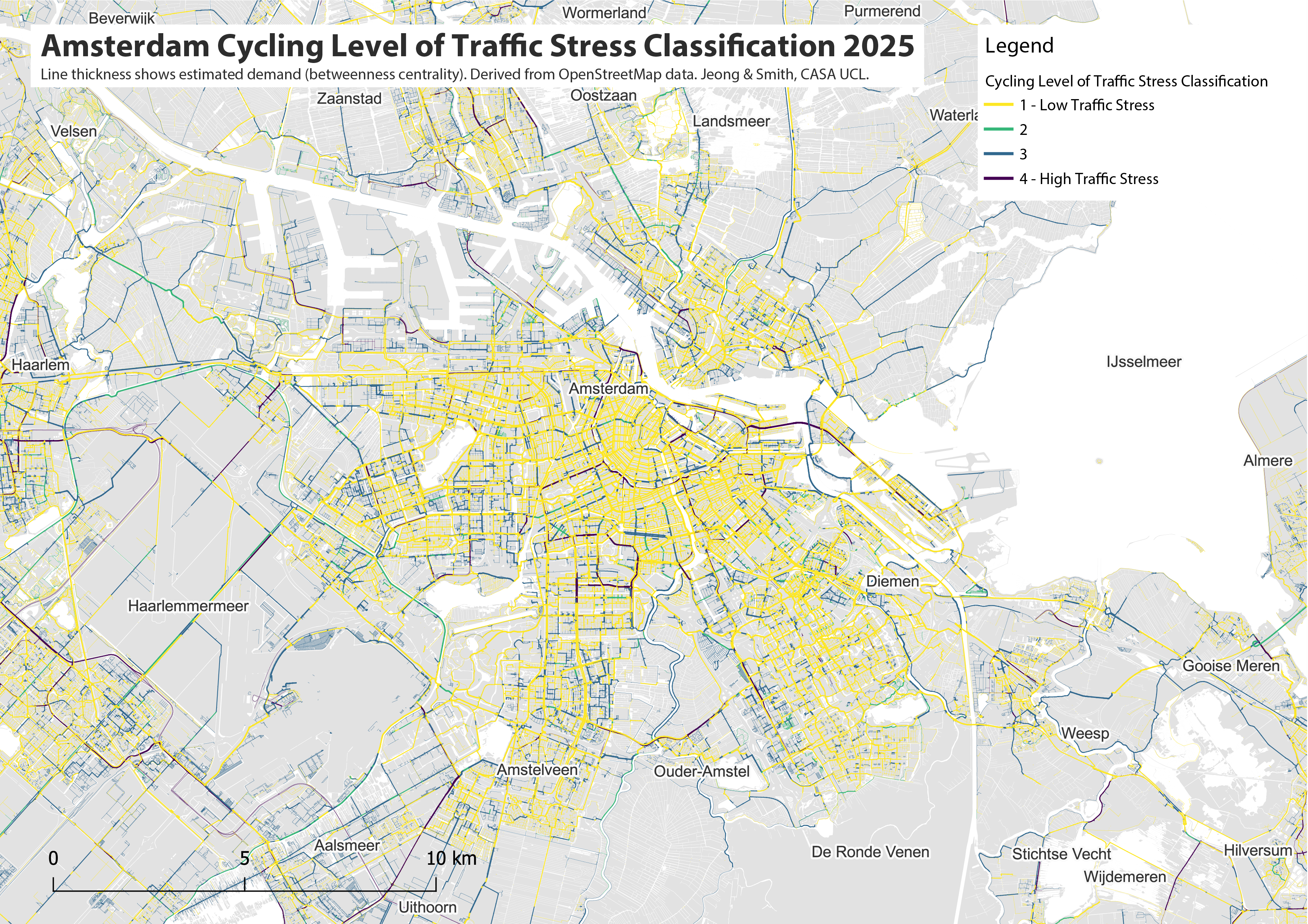
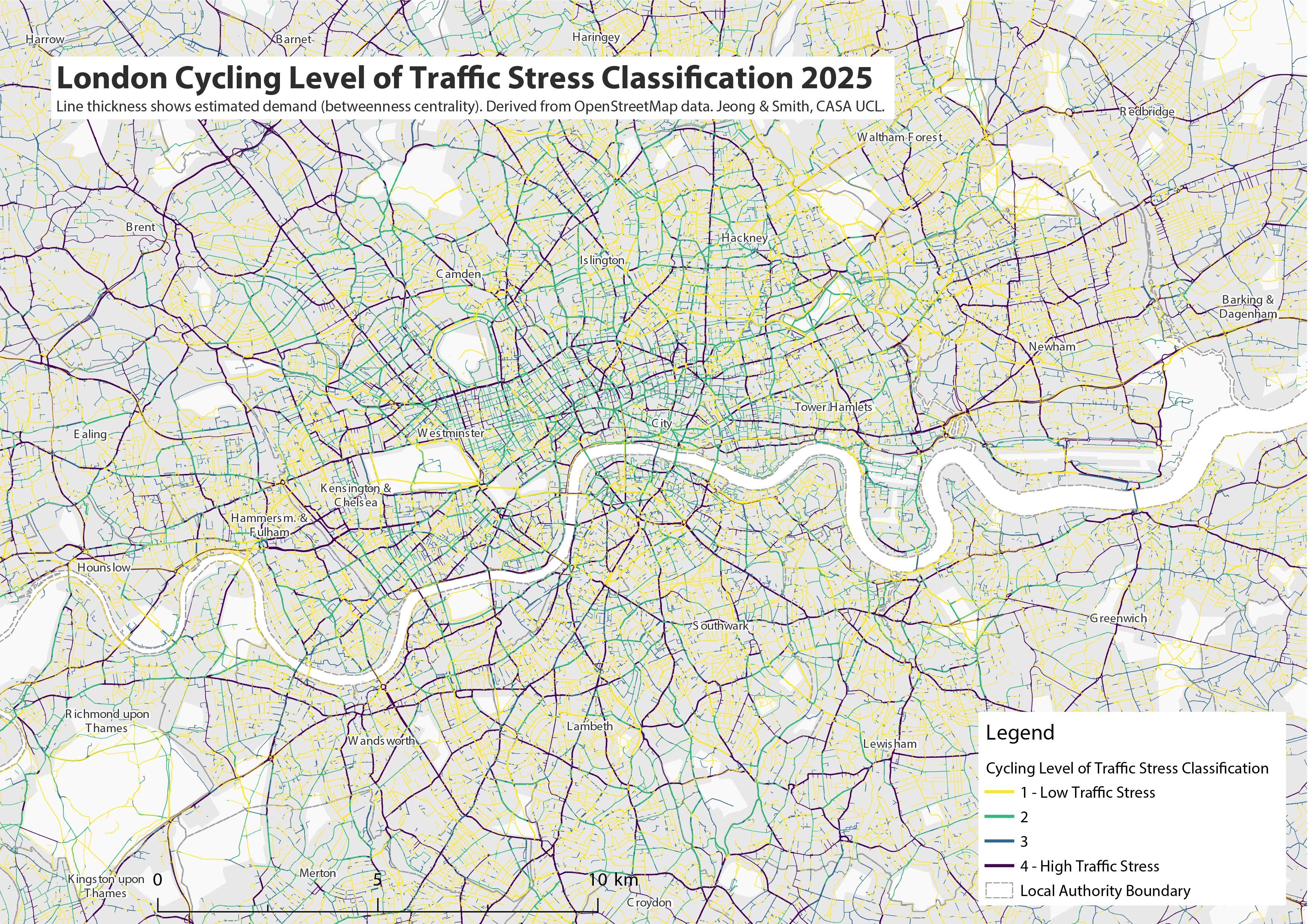
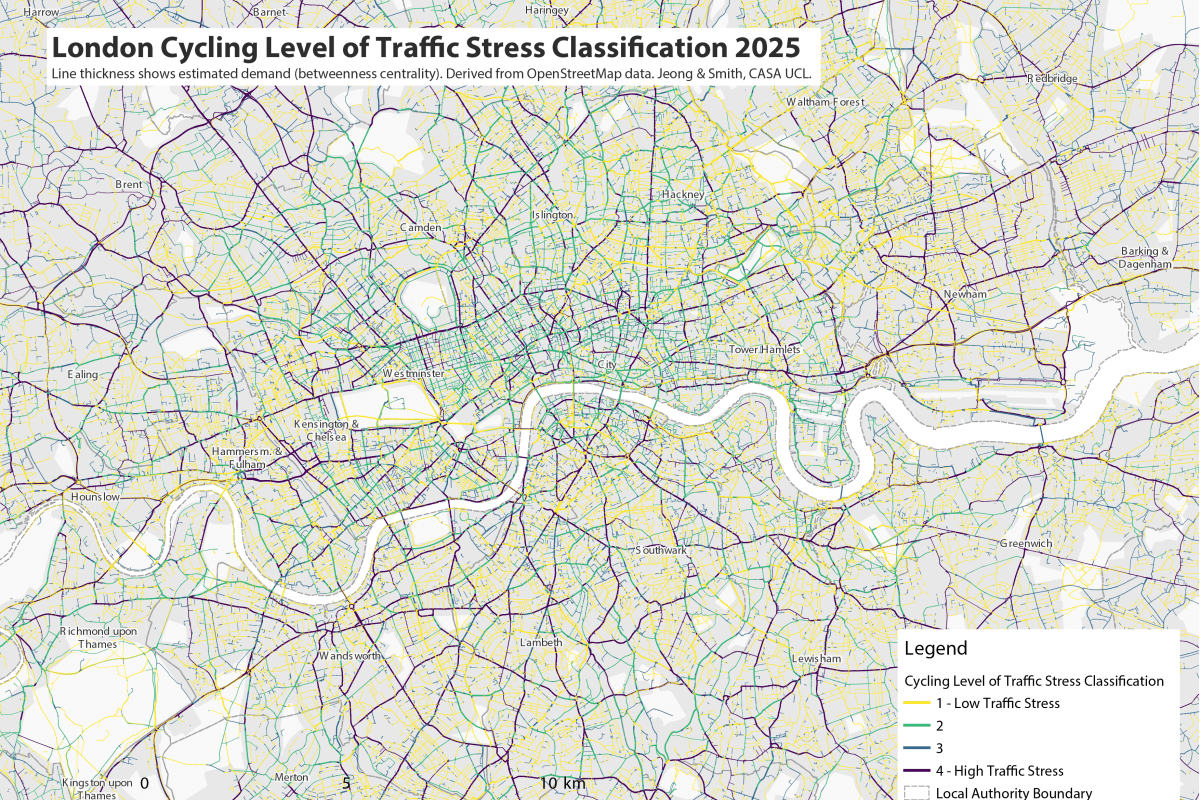
Level of Traffic Stress The experience of cycling can also be affected by other factors in addition to cycle lanes, such as traffic speed, road type and number of carriageways. This is the approach taken in the Level of Traffic Stress (LTS) framework, which has been adapted here to reflect conditions in European cities (see the methodology paper for more details). LTS produces a classification from 1-4, with LTS 1 being low stress conditions suitable for all cyclists, and LTS 4 being stressful conditions mixing with higher speed traffic, suitable only for experienced cyclists. In the maps below, we can see again the massive contrast between Amsterdam and London, with Amsterdam dominated by the yellow colour of the least stressful cycling conditions. There are more mixed conditions in some settlements in the wider Amsterdam region. Note also we are not considering cycle lane capacity in this measure, and the very high volume of cyclists in central Amsterdam (and more recently in parts of central London) can itself increase journey stress. In London, the inner city falls mainly into LTS 2 (due to widely implemented 30km/h speed limits) but major roads outside of Inner London are overwhelmingly in the most stressful LTS 4 classification, increasing levels of danger for cyclists and discouraging less experienced cyclists to switch modes.
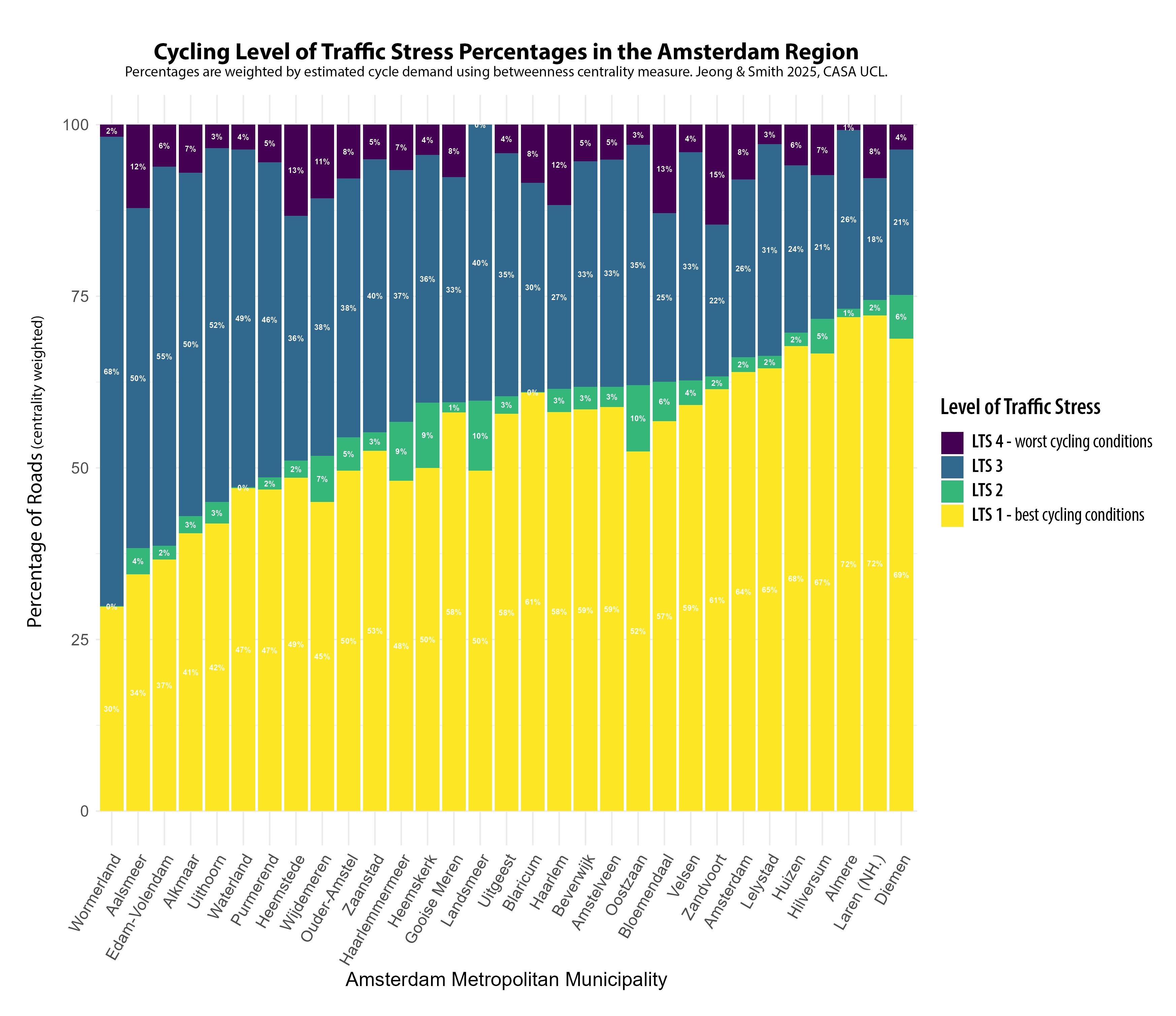
The Level of Traffic Stress framework can also be used to create a statistical summary for authorities. LTS 1 is the dominant classification in the Amsterdam region, comprising more than half of the centrality weighted roads for most authorities, and 64% of roads in the City of Amsterdam. Comprehensive cycle lanes ensure that the most stressful traffic classification of LTS 4 is minimised across the metropolitan region, averaging around 7%. There is however a moderately high percentage of LTS 3, which likely reflects protected cycle lanes being next to higher-speed main roads and that 30 km/h speed limits could be further extended.
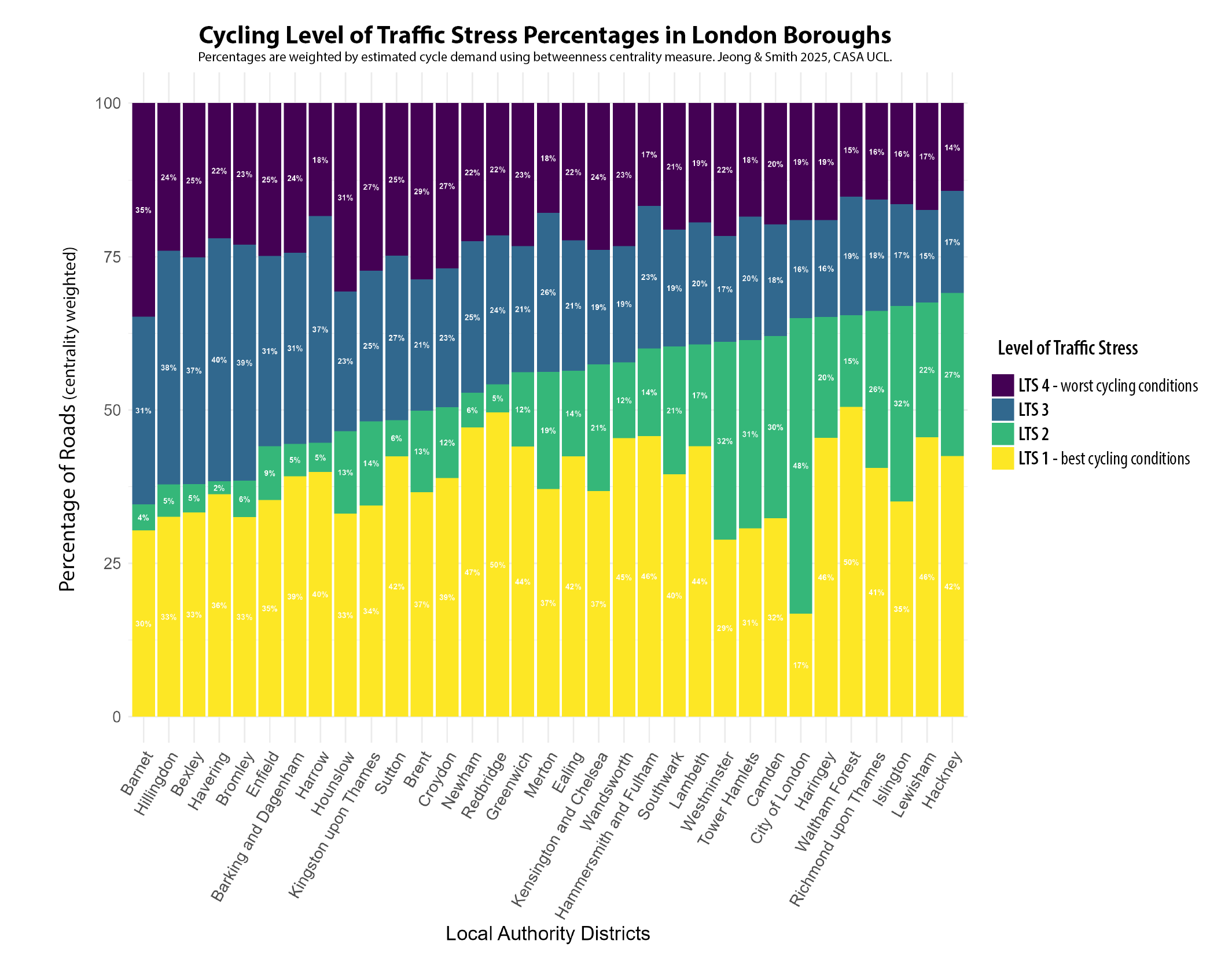
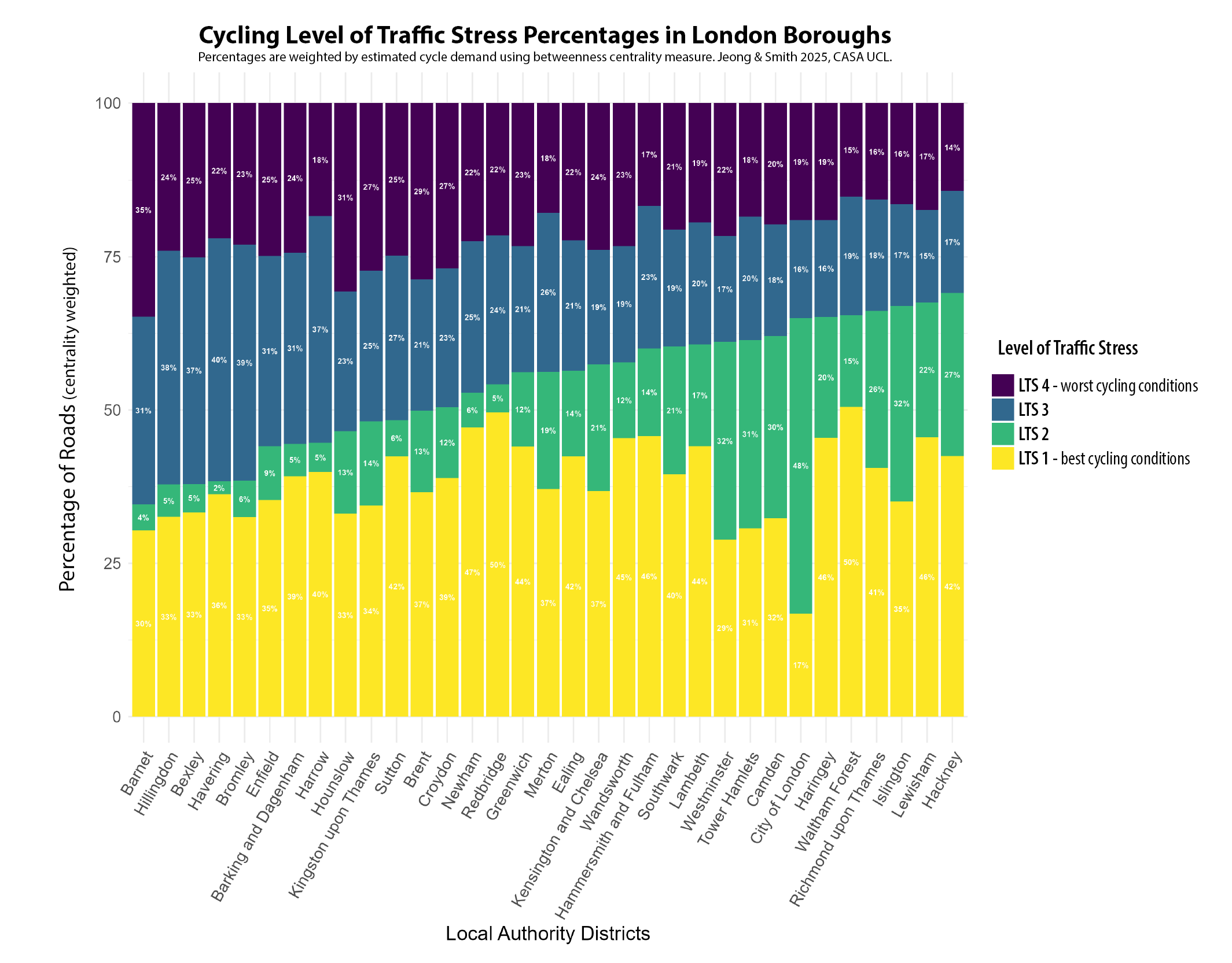
London has widely implemented 30km/h speed limits, which despite the lack of protected cycle lanes, increases the volume of roads falling into the LTS 2 category, particularly in Inner London boroughs. But a major problem, and contrast with the Amsterdam results, is just how prevalent LTS 4 roads are throughout London, averaging around 20% of all roads. These represent roads where cyclists are forced to mix with higher speed traffic, and are currently a major obstacle to providing safe and inclusive cycling conditions for many London residents.
Conclusions This post has shown how the analysis of cycle network data can be used to create indicators of cycle network quality, tracking progress towards sustainable and inclusive cities, and producing comparative city indicators. In this case the gap between the leading city of Amsterdam and London is huge in terms of the comprehensiveness and quality of cycle networks, and the experience of cycling in terms of Level of Traffic Stress. The only limitations in the Amsterdam metropolitan region were found to be in some of the more rural authorities, particularly in Noord-Holland, and potentially the need to expand 30 km/h speed limits. For London, major expansion in protected cycle lanes is needed in many parts of the city to try and achieve a more comprehensive and inclusive network, as currently there are major limitations in London’s cycle infrastructure network.
The ENHANCE Project and Next Steps You can read the full working paper of this research here, by Philyoung Jeong and Duncan Smith at CASA UCL. For future work we intend to expand this measure to other European cities, as it is based on open international data. Future improvements could also include considering cycle lane capacity and further improvements to the network analysis of cycle route demand. This research is part of the ENHANCE Project, a Driving Urban Transitions project funded by the European Union and ESRC.
Increasing levels of cycling is a key part of the transport strategies of many global cities with the potential for significant health and sustainability benefits. Many urban cycle networks are however fragmented and poor-quality which can significantly limit participation. London is currently expanding its cycling infrastructure to catch up with leading European cities in active travel. How can we track recent progress towards developing comprehensive, safe and inclusive cycle networks?
Cycle Infrastructure and Level of Traffic Stress This research uses two main perspectives to review cycling networks. The first is based on cycle infrastructure, where we map the geography and quality of cycle lanes. From this view, protected cycle lanes that are physically separated from traffic are higher quality than cycle lanes that are merely paint on the side of the road, or that are shared with other vehicles, such as a bus lane. Cycle infrastructure is mapped for London below, derived from OpenStreetMap data-
The Mayor and Transport for London have been developing a city-wide network of Cycleways – protected cycle lanes – that appear in bright blue on the map, mostly running east-west through Inner London. Cycle lane provision in north-west and south-west London is generally weaker, with more car-dependent and suburban boroughs, as well as hillier topography. London’s most cycle-friendly boroughs are generally in Inner London. You can see in the map that pro-cycling boroughs such as Hackney and Islington have many advisory cycle lanes (in purple on the map), which include Low Traffic Neighbourhoods, Quietways and shared bus lanes.
Our second perspective on cycle network quality is the popular Level of Traffic Stress framework, which takes a wider perspective on road conditions affecting cyclists, including road width, speed limits and the type of road (e.g. residential road, high street, arterial road etc.). The Level of Traffic Stress framework is a categorical scale from LTS 1 – the safest conditions suitable for more vulnerable cyclists – to LTS 4 – the most stressful conditions mixing with higher speed road traffic, only suitable for experienced cyclists. The Level of Traffic Stress framework for all of London’s roads is mapped below, again using OpenStreetMap data-
The Level of Traffic Stress framework produces a much larger contrast between Inner and Outer London, with Inner London generally having lower speeds and lower stress cycling conditions. In Outer London, cycle-friendly residential neighbourhoods are typically bounded by high-speed unsafe main roads, reducing cycle accessibility. There are some Outer London boroughs that break this trend as we discuss below.
Developing Borough-Level Indicators of Cycle Network Quality In this research we wanted to transform the cycle infrastructure and Level of Traffic Stress data into indicators that accurately summarise the quality of cycle networks at the borough level. A key step here is that the most in-demand cycle routes need to be weighted higher than infrequently used routes, to give a representative picture of cycle network quality based on the routes cyclists actually need to use. This step has been achieved by calculating betweenness centrality to typical Point of Interest destinations, validated against TfL cycle count data (see the working paper for details).
The infrastructure summary indicator is below, ordered by the weighted percentage of protected cycle lanes. Outer London boroughs score better than expected with this indicator, led by Waltham Forest, Richmond and Hounslow. These boroughs have invested in fully segregated cycle networks, such as the mini-Holland funding scheme used to improve cycle networks in Waltham Forest. Cycle routes through parks and along rivers/canals also play an important role, with Richmond and Redbridge having the highest proportions of off-road cycle routes. Inner London boroughs such as Hackney and the City of London have a higher proportion of unprotected cycle lanes (such as bus lanes and Low Traffic Neighbourhoods) and do not score as well in terms of fully protected infrastructure.
The second Level of Traffic Stress (LTS) indicator measures a wider set of road conditions – such as speed limits, width and type – and includes all roads in Greater London (except where cycling is illegal such as motorways). A similar centrality-weighted chart by borough is shown below. There is a much clearer split between Inner and Outer London boroughs using LTS, with seven of the top ten boroughs being in Inner London – led by Hackney, Lewisham and Islington – and the bottom 13 boroughs all being in Outer London. This reflects lower speed cycle-friendly conditions in Inner London. Outer London boroughs feature higher proportions of LTS 3 and LTS 4 roads, due to the presence of more stressful, higher speed main roads, outside of the relatively sparse segregated cycle network. Richmond and Waltham Forest remain the exceptions, achieving good cycling conditions in Outer London and featuring in the top ten boroughs. Inner London boroughs that have pursued Low Traffic Neighbourhood and Quietway approaches, such as Hackney and Islington, score very well in the LTS classification as this measure favours lower speed cycling conditions.
To summarise these indicators, we have produced a borough ranking of the Cycle Infrastructure and the Level of Traffic Stress indicators, and an overall Cycle Accessibility Score, combining infrastructure and LTS, as shown in Table 1 below. Hackney, Islington and Hammersmith & Fulham are the best ranked Inner London boroughs overall, and Waltham Forest, Richmond and Haringey are the best ranked Outer London boroughs. Waltham Forest scores particularly well, coming in first overall for Greater London. In terms of the weakest London boroughs for cycling, these are car-dependent Outer London boroughs such as Barnet, Bexley and Brent. These boroughs currently fall outside of the TfL Cycleway network and have not managed to develop their own cycle networks in more car-dependent conditions. The weakest Inner London borough is Kensington & Chelsea, which has historically resisted developing its cycle network and came last in the cycle infrastructure ranking, despite being a high density Inner London borough that is adjacent to Hammersmith & Fulham which is at the opposite end of the results
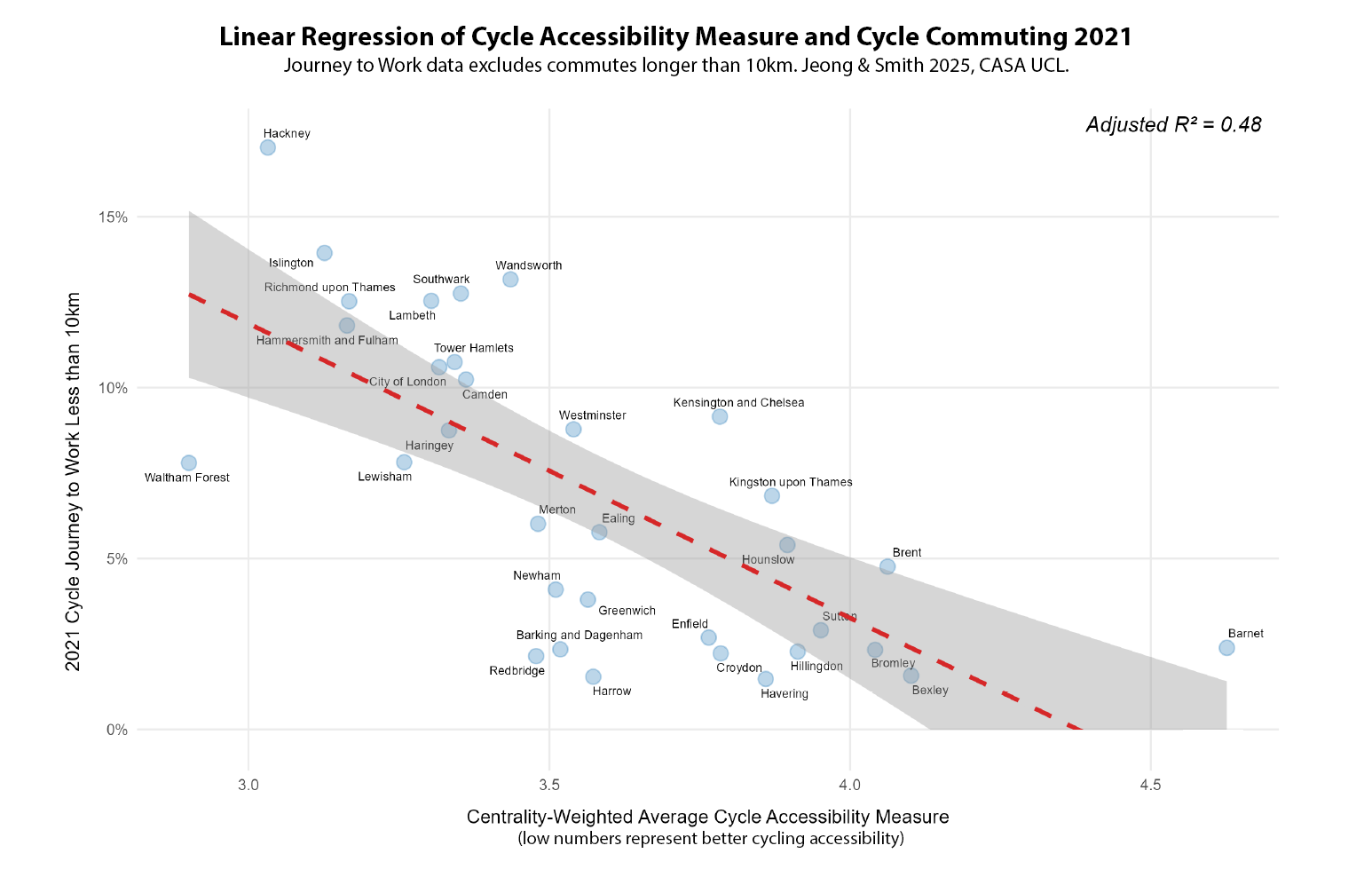
Comparing the Cycle Accessibility Measure to Travel Behaviour We can also compare the cycle accessibility score to recorded levels of cycling in travel survey data. A linear regression between the cycle accessibility measure (lower is better with this indicator) and recorded levels of cycle commuting in 2021 is shown below. Some boroughs with strong cycle networks, such as Hackney and Islington, have rates of cycle commuting even higher than expected, coming above the regression line. Waltham Forest has lower than expected levels of cycle commuting, though this may reflect being located further from job opportunities, as is the case for many Outer London boroughs. Some boroughs with weaker cycling infrastructure still show reasonable cycle commuting levels, such as Kensington & Chelsea, reflecting that some cyclists are willing to endure more stressful conditions. This approach is unlikely however to expand cycling participation beyond more experienced cyclists. Actual cycling rates reflect additional factors to cycling networks, such as demographics and public transport accessibility.
The ENHANCE Project and Where to Find Out More You can read the full working paper of this research here, by Philyoung Jeong and Duncan Smith at CASA UCL. This research is part of the ENHANCE Project, a Driving Urban Transitions project funded by ESRC. Future work will be expanding these indicators across the UK, and making comparing accessibility in the UK with partner cities in the Netherlands and Portugal.
Although Greater London has an extensive transit network, this is not the case for many UK cities where underinvestment and privatisation has seen bus, metro and rail networks stagnate in recent decades, falling well behind European peers. Improving public transport is an important aspect of addressing the UK’s regional inequalities and poor productivity, and is a prominent issue for the 2024 general election.
Accessibility measures are an ideal tool to gauge the comprehensiveness and efficiency of public transport networks – they describe the ease with which populations can reach key services by different travel modes. The leading UK urban thinktank, the Centre for Cities (see their new Cities Outlook report 2024), has been doing some accessibility analysis of English cities compared to continental European cities, and this was recently republished in the Financial Times in an article on productivity challenges-
It’s great to see accessibility analysis feature in the media. The measure used above however has some serious problems leading to nonsensical results (e.g. does Manchester really have half the accessibility of Liverpool and Newcastle?). The Centre for Cities measure uses a single time threshold (30 minutes) when we know that accessibility varies considerably at different time thresholds. It is based on a single destination point, when cities can have multiple employment centres. And it describes accessibility as a percentage of all city jobs, which means that the smaller the urban settlement is, the higher the accessibility result will be using this measure. In reality, larger city-regions have better jobs accessibility.
Creating Robust Public Transport Accessibility Measures – R5R and PTAI-2022 We can create much better and more reliable accessibility measures for UK cities. There have been significant recent advances. The open source R5R software has solved many of the computational challenges for accurately calculating public transport accessibility, allowing the calculation of full travel matrices for all possible trips and handling accessibility variation over time. In the UK, Rafael Verduzco and David McArthur at the Urban Big Data Centre have taken this one step further and pre-calculated accessibility indicators for all of Great Britain at a range of time thresholds in their Public Transport Accessibility Indicators dataset. This dataset is calculated using R5R, and is based on the median travel time across a three hour travel time window, 7am to 10am on a typical weekday (Tuesday 22nd November 2021), and uses the latest public transport service datasets such as the Bus Open Data Service. The results are at LSOA scale for GB only (no Northern Ireland), based on census 2011 zones (so I have used 2020 population data in the below analysis).
Origin and Destination Accessibility Measures This article focuses on jobs accessibility, and this can be analysed from either the perspective of trip origins (residential-based accessibility to jobs) or from the perspective of trip destinations (workplace-based accessibility by residents). Both perspectives are complementary, and are developed below. For residential measures, if we take the average accessibility for all residents in a city then we get a good overview of how extensive and efficient the public transport network is. This requires city boundaries to define all the residents in each city. The analysis below uses the Primary Urban Area geography.
Public Transport Jobs Accessibility Trip Origin Results The table and chart below show average accessibility to jobs for residents in all major GB cities by three travel time thresholds- 30 minutes, 45 minutes and 60 minutes. London’s accessibility results are inevitably much higher than any other GB city, being around 3 to 4 times higher at all three travel times, and emphasising just how big the gap is between the capital and all other GB cities. The 30 minute threshold describes shorter trips, and identifies higher density compact cities where residents are on average closer to employment centres. Small compact cities such as Cambridge and Oxford score well at 30mins (though note this is not the case at 45 or 60mins). Edinburgh and Glasgow have the highest residential average accessibility outside of London at both 30 and 45 minutes. This is due to Scottish cities historically following a higher density European urban model, and maintaining better public transport networks by avoiding some of the worst effects of privatisation.
The 60 minute accessibility measure picks up longer distance commuting on regional rail and metro networks. This is where the strengths of larger city regions such as Greater Manchester and the West Midlands are highlighted, with Manchester second and Birmingham forth in the ranking (Glasgow is third and also has a large regional rail network). Given their large populations, Manchester and Birmingham should however be scoring higher in absolute terms and closing the gap on London. Both have poor accessibility for the shorter 30 minute accessibility measure, reflecting the need for further inner-city densification (as the Centre for Cities have argued). For longer commutes, Manchester and Birmingham metro networks should also continue to be extended regionally. Leeds scores relatively well at 30 minutes due to its medium-density urban core, but it lacks a metro and is behind Birmingham, Glasgow and Manchester for the longer commuting times.
Peak Public Transport Accessibility by Trip Destination We can also analyse accessibility by trip destination, which produces similar results to the trip origin residential measure but is more from the perspective of employment centres. The table below shows the peak accessibility by workplace within each Primary Urban Area, which is a measure of labour market size and agglomeration potential for the UK’s largest city centres. London retains its huge advantage with this measure, at 3 to 4 times higher than the next best cities. City-regions with larger rail and metro networks score better with the peak destination measure, with Birmingham and Manchester ranked second and third respectively, exceeding 2 million people at 60 minutes. Cities with strong rail connections to London, such as Reading and Crawley, also score highly at 60 minutes, but have much lower accessibility at 45 and 30 minutes. Smaller compact cities such as Edinburgh and Cambridge rank much lower by the destination measure compared to the residential analysis.
Both the trip origin residential average accessibility measure and the trip destination peak accessibility measure provide useful perspectives. The residential average measure is a good summary of the coverage and extent of public transport across a city, and how likely residents are to use public transport modes. The trip destination peak accessibility measures employment centre labour market size, and summarises the total number of people that can reach city centres by rail and metro. This is a better measure of agglomeration potential and is more closely correlated with city-region size.
Mapping the Accessibility Results We can also map the results to view the geography of accessibility to jobs. Firstly the trip origin accessibility to jobs measure. This emphasises how large the area of high accessibility is across Greater London, with parts of Outer London and the South East having higher accessibility to jobs than residents in the city centres of the next largest cities, Manchester and Birmingham. The Primary Urban Area geography is also shown, which is the basis of the residential average accessibility chart and table shown above.
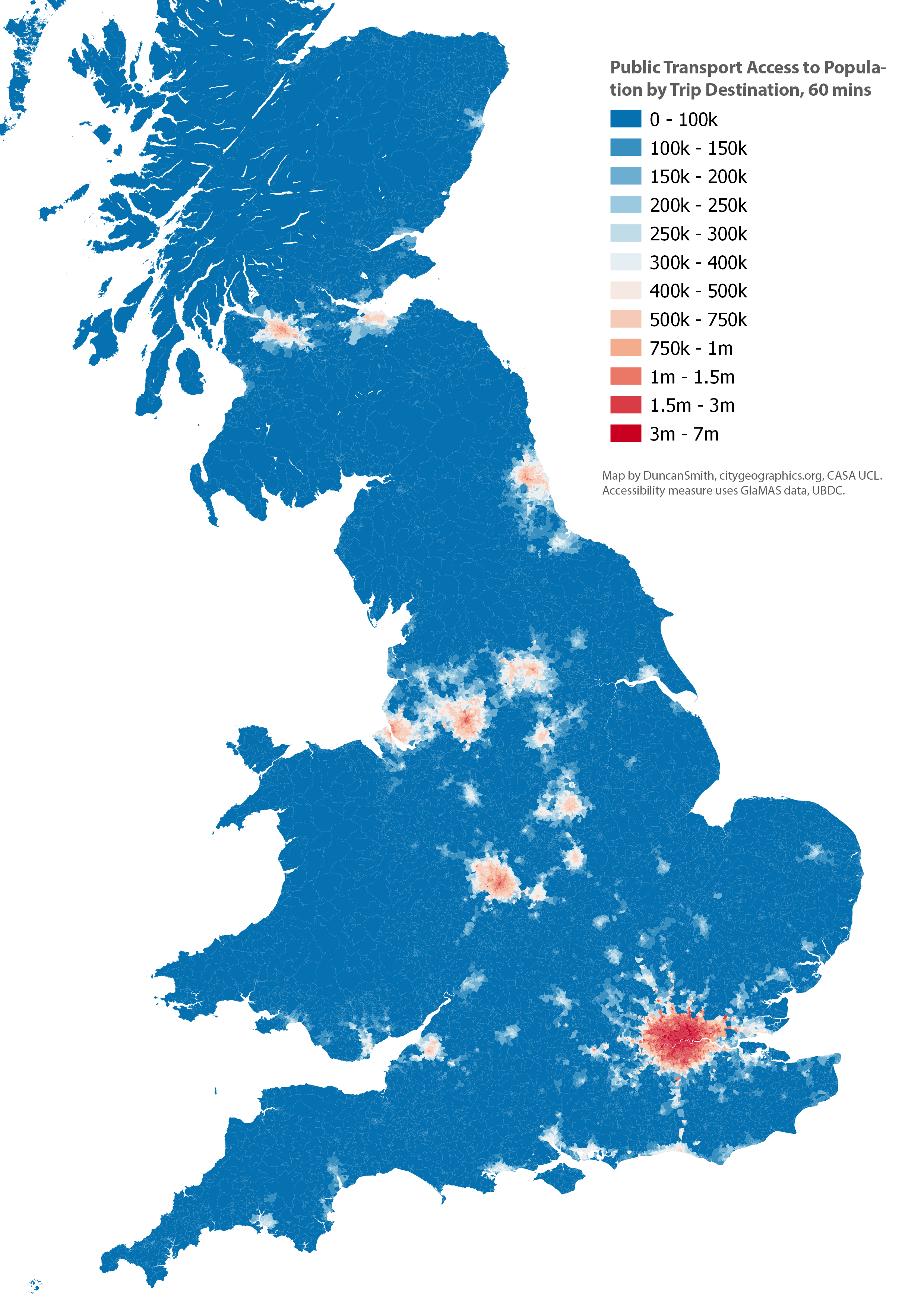
Next we map the trip destination accessibility to population measure. This has a very similar geography, but with more of an emphasis on city centres, as we are measuring average accessibility on a weekday 7am-10am when there will be more commuting services going to, rather than from, central areas. Again London has a huge advantage, peaking at 7 million people. We can also see the centres of Birmingham and Manchester reaching accessibility levels above 2 million people, while Glasgow, Leeds, Newcastle and Liverpool exceed 1 million.
Conclusion- Open Data and Software is Available to Create High Quality Accessibility Measures With software such as R5R (see this workshop for an intro) and the exemplary and easy to use PTAI-2022 dataset from the UBDC, it is easier than ever to produce accurate public transport accessibility measures. The comparative accessibility analysis of GB cities shown here has highlighted the huge accessibility gap between London and all other UK cities. It has also shown the generally better accessibility performance of Glasgow and Edinburgh, and the high regional accessibility of Birmingham and Manchester which contrasts with their weaker accessibility in these regions for shorter travel times, which supports inner-city densification. There is no single perfect accessibility measure that answers all questions we are interested in – this analysis has confirmed that variation at different travel times reveals contrasting patterns in local and regional accessibility; that average and peak accessibility in cities emphasise different aspects of transit networks; and that trip origin and trip destination measures provide complementary perspectives. We therefore need to test a range of measures to understand accessibility patterns.
Future Improvements This has been a relatively quick demonstration of the PTAI-2022 data and there are several areas for further improvements-
Including European cities for comparison would be very interesting, as the Centre for Cities explored in their original analysis. A recent major paper in Nature has shown how accurate international accessibility comparisons can be done- https://www.nature.com/articles/s42949-021-00020-2.
The PTAI-2022 dataset is a really good tool that makes GB accessibility analysis much more straightforward for researchers. Currently it uses the 2011 census boundaries, and the next update should use the 2021 boundaries allowing the latest census data to be used. Additionally, the current PTAI-2022 release uses 2021 public transport data, and updating this with the latest rail and bus data would also be a useful update. A related issue is that reliability on UK public transport networks can be poor, and that timetables can overestimate transit accessibility. This topic has been analysed by Tom Forth in this blog post.
This analysis has used the Primary Urban Area geography, which is a useful description of GB city-regions, but there are some issues with PUAs due to the underlying local authority geography. A few PUAs for medium-sized cities have quite large hinterlands (e.g. Sheffield) and this lowers the average accessibility measured in these PUAs due to lower accessibility outside of the urban core. A more thorough analysis of accessibility would need to test multiple urban geographies and gauge the extent of Modifiable Areal Unit Problem variation.
The housing crisis in London has become increasingly severe in the last decade with much higher prices, rents, and largely static incomes, while housing development volumes have remained consistently below targets. Green Belt reform is often cited as a solution to boost development, though this has been off the agenda during the last 13 years of Conservative government. Recent announcements by the Labour leadership, supporting Green Belt reform and setting ambitious targets for housing development, could change this state of affairs with the general election coming in 2024.
This article analyses housing development in the London region from 2011-2022 (full CASA Working Paper here), using the Energy Performance Certificate Data. There is strong evidence that the Green Belt is a major barrier to development and is in need of reform. On the other hand, there are very substantial challenges around the quality and sustainability of new build housing in the South East. The analysis shows that, outside of Greater London, new build housing typically has poor travel sustainability and energy efficiency outcomes. Any release of Green Belt land needs to be dependent on travel sustainability criteria and improved energy efficiency for new housing. Sustainable housing outcomes are much more likely to be achieved through prioritising development in existing towns and cities and in Outer London.
London’s Housing Affordability Crisis House prices in London doubled between 2009 and 2016, pricing out households on moderate and low incomes from home ownership, and translating into rent increases, longer social housing waiting lists, increased overcrowding and homelessness (see Edwards, 2016; LHDG, 2021). Price rises are linked to on the one hand to the financialization of housing (exacerbated by record low interest rates and Help to Buy loans in the 2010s) and on the other a long period of low housing supply, stretching back to the 1980s and the erosion of public housing.
The impact is record levels of unaffordability, with Inner London average house prices reaching £580k and Outer London £420k in 2016 (see chart below). The median house price to income ratio for Inner London soared from 9.9 in 2008 to 15.1 in 2016; for Outer London the ratio increased from 8.2 in 2008 to 11.8. In addition to high prices, first-time buyers have also been hit with record mortgage deposit requirements, with average deposits reaching £148,000 for Greater London, compared to around £10,000 in the late 1990s (Greater London Authority, 2022). Owner occupation is now effectively impossible in Inner, and much of Outer, London for low and moderate income buyers.
There have also been substantial increases in prices across the London region. The map below shows prices per square metre in the South East showing four radial corridors of high prices extending beyond Greater London into the Green Belt. East London is increasingly mirroring West London with two radial corridors of higher prices extending north-east and south-east from Inner East London. These are the primary areas of gentrification in London in the last decade (discussed in previous blog post), squeezing out what was the largest area of affordable market housing. There is also a distinct spatial alignment between London’s Green Belt boundary and higher prices, which is evidence of regional housing market integration, and that Green Belt restrictions are pushing up prices.
New Build Housing Delivery in the London Region Greater London has struggled to meet its housing targets in the last decade. The current London Plan target is for 52k annual completions, which, as can be seen in the graph below, London is significantly short of. The 52k annual target has been criticised as being too low, with other estimates of housing need calculating that 66k or even 90k houses per year are needed (LHDG, 2021). Given the extremely high prices, affordable housing tenures are needed more than ever, yet affordable housing delivery has fallen in the 2010s (although note there has been progress in affordable housing starts in the last two years). Finally, the recent impacts of the pandemic and high interest rates have hit market housing activity, meaning that London will very likely continue to miss its overall housing targets for the next 2-3 years.
We can look in more detail at the geography of housing delivery at local authority level in the scatterplot below. There is high development in most of Inner London, and some Outer London boroughs. These boroughs contain Opportunity Areas (major development sites in the London Plan): Canary Wharf in Tower Hamlets; the Olympic Park in Newham; Battersea Power Station in Wandsworth; Hendon-Colindale in Barnet; Wembley in Brent; Old Oak Common-Park Royal in Ealing; and Croydon town centre. Given that there are only a few Opportunity Areas in Outer London, this leads to relatively low delivery in most Outer London boroughs, and points to the need for a wider strategy for Outer London development.
Meanwhile, there is low development activity in nearly all Green Belt local authorities, much lower than London boroughs and also below the average for the rest of the South East. Green Belt restrictions affect both local authorities in the commuter belt and also Outer London boroughs as well (e.g. Enfield, Bromley) with 27% of Outer London consisting of Green Belt land. We can confirm how rigidly Green Belt restrictions are being applied using the official statistics, which calculate that the London region Green Belt land area was 5,160km2 in 2011 and 5,085km2 in 2022 (DLUHC, 2023). Therefore, only 74km2 or 1.4% of Green Belt land was released over the decade (this figure is for all development uses, not only housing), which is strong evidence of minimal change.
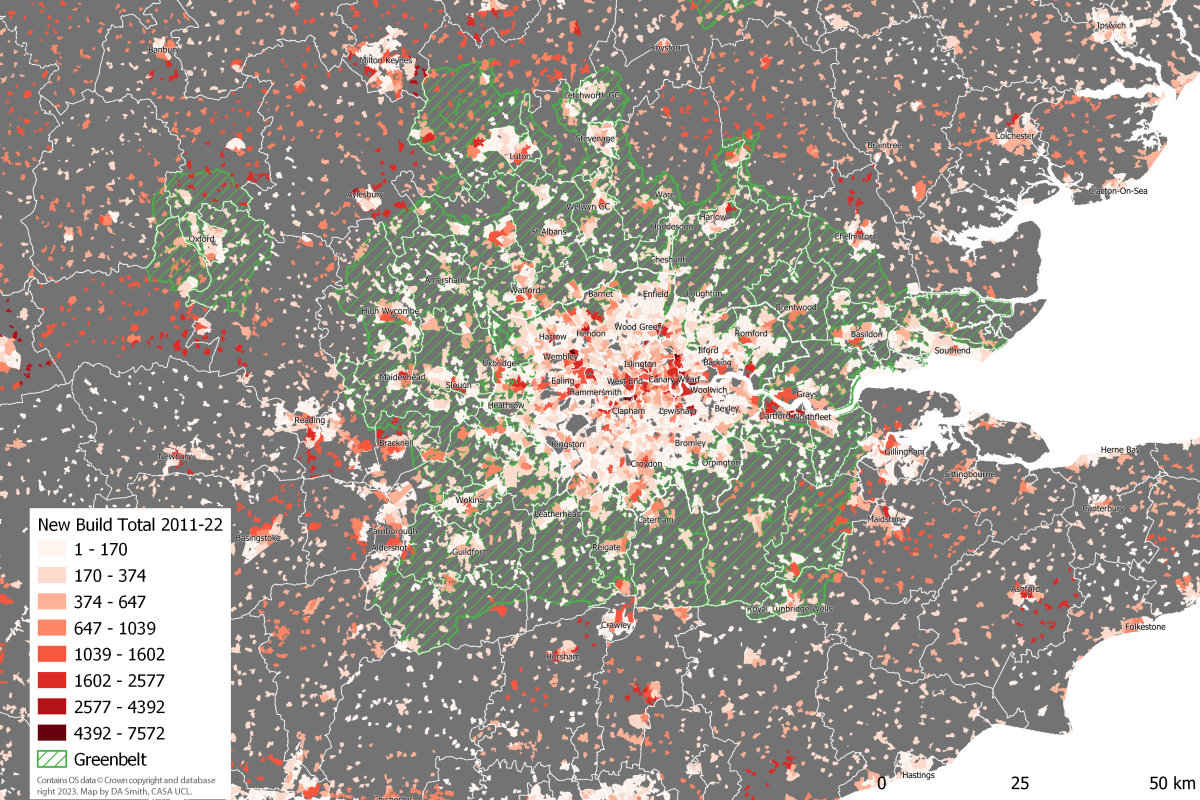
One final impact of the Green Belt can be seen by mapping development in the last decade as shown below. In addition to the patterns of high development in Opportunity Area sites, and generally low development in the Green Belt, there is a ring of high development activity just beyond the Green Belt boundary. This ring includes dispersed car-dependent development in semi-rural areas, and the expansion of medium-sized towns and cities such as Milton Keynes and Reading. This pattern looks very much like Green Belt restrictions are pushing development beyond the Green Belt boundary, creating sprawl-type patterns in several authorities. One important caveat is that several South East cities have strong economies in their own right, particularly technology industries in the Oxford-Milton Keynes-Cambridge arc, creating local development demands in addition to London-linked demand.
Potential for Green Belt Reform With Greater London consistently falling short of housing targets, reform of the Green Belt has been cited as a promising solution (see for example Mace, 2017; Cheshire and Buyuklieva, 2019). The release of Green Belt land could greatly boost development and ease prices. Green Belt reform could also be a substantial source of revenue for austerity-hit local authorities, if authorities are given the powers to purchase Green Belt land at current use value and benefit from the land value uplift (this is part of the Labour proposals).
Traditional objections to Green Belt development focus on rural land preservation. Yet the Green Belt is massive in scale – 12.5% of all the land in England is Green Belt. London’s Green Belt is 5,085km2, or three times bigger than Greater London. Medium density housing development would take up a small proportion of this land. For example, building 100k dwellings at a gross density of 40 dwellings per hectare would add up to 25km2, or less than 0.5% of the London region’s Green Belt. Appropriate Green Belt reform could simultaneously allow for a moderate increase in development and improve environmental aspects of the Green Belt – the current environmental record of the Green Belt is mediocre on key measures such as biodiversity – through green infrastructure funding and principles of Net Biodiversity Gain. The land preservation arguments against Green Belt development do appear to be solvable. There are however further sustainability impacts from housing development to consider, including transportation and housing energy impacts, as discussed below.
Sustainability Impacts- Travel Transport is the largest source of GHG emissions in the UK – 26% of all emissions in the latest 2021 data (DBEIS, 2023). The route to Net Zero requires both the electrification of transport systems and a significant mode shift from private cars to public transport, walking and cycling (HM Government, 2021). Greater London is a UK leader in sustainable travel, but this is not the case for the wider London region, much of which is car dependent. The analysis here uses car ownership and commuting mode choice data from the 2021 census to create a Travel Sustainability Index, as shown in the table below, which classifies Greater South East residents into 6 travel classes of around 4 million people. The South East covers a very wide range of travel behaviours, from an average of 20% commuting by car and 62% zero car households in the most sustainable class 1; to as high as 87% car commuting and 6% zero car households in the most car-dependent class 6.
Travel Sustainability Classes Average Statistics (2021 Census data)
Travel Sustainability Class
Travel Sustain. Index
Car Commute %
Public Transport Commute %
Walk & Cycle Commute %
Car Owning Households %
Residential Net Density (pp/km2)
Total Pop. in South East
1
45-82
20.3
48.5
26.4
38.3
51.5k
3.56m
2
30-45
41.6
33.2
20.9
61.5
32.1k
4.03m
3
21-30
60.6
18.1
17.6
74.7
25.0k
4.03m
4
15-21
71.6
10.9
14.2
83.3
20.2k
4.16m
5
10-15
80.0
6.5
10.9
89.4
16.4k
4.34m
6
1-10
87.3
3.6
6.7
94.1
11.1k
4.29m
Mapping the travel sustainability classes highlights the stark travel behaviour differences between Greater London and the wider region. The Inner London population-weighted average travel sustainability score is 51.6 (class 1), and Outer London is 32.1 (class 2). The Green Belt is overwhelmingly in car dependent classes 4 and 5, with an overall population-weighted average of 16.4 (class 4). The Rest of the South East has a population-weighted average score nearly identical to the Green Belt at 16.5, emphasising the disappointing levels of car dependence in the Green Belt despite its rail infrastructure and proximity to London.
The patterns shown in the above map clearly present a challenge for Green Belt development, as new housing in the wider region risks extending patterns of car dependence. Car dependent areas include some locations next to rail stations (proximity to rail stations has been advocated as a criteria for prioritising Green Belt land for housing). We can directly measure the travel sustainability of housing development from the last ten years by matching the output areas locations of new housing to the Travel Sustainability Index scores. This is shown in the scatterplot below, where Inner London boroughs score highly with this measure, followed by Outer London. Much of the housing development in the wider region scores poorly in terms of travel sustainability, including in areas with high housing development such as Bedfordshire and Milton Keynes.
Although travel sustainability is generally low in the wider region, there are trends identifiable in the above results that can be used as basis for guiding more sustainable development. Several towns and cities show moderately sustainable travel outcomes, including the Green Belt towns Luton, Watford, Guildford and Southend, and wider South East towns and cities Brighton, Reading, Oxford, Cambridge, Portsmouth, Norwich and Southampton. Generally, development in existing towns and cities is likely to be more sustainable than developing smaller settlements and more dispersed rural areas. There are also noticeably better results in active travel-oriented cities such as Brighton and Cambridge. Overall, if we want Green Belt housing development to minimise travel sustainability impacts, then it would be most realistic to achieve this by extending existing towns and cities, both within the Green Belt and in the wider South East. Promoting development in Outer London boroughs also looks to be an efficient strategy given generally good travel sustainability levels in Outer London, and that Outer London is 27% Green Belt land.
Sustainability Impacts- Energy Another important sustainability impact of new build is energy use and carbon emissions resulting from space and water heating, which we can estimate from the Energy Performance Certificate data as shown below. CO2 emissions per dwelling are considerably lower in Inner and Outer London, with overall London emissions per dwelling around two thirds of the value for the Green Belt and Rest of the South East. This is only partly due to smaller dwelling sizes, as CO2 emissions per square metre in London are significantly lower as well. The lower emissions in London housing can be explained by the much higher proportion of flats and also the use of community/district heating, with three quarters of all new build in Inner London and 47% of new build in Outer London connected to community heating networks. The community heating approach is only efficient for high density developments. For medium and lower density developments, air and ground source heat pump technologies are a key technology for improving energy efficiency and replacing gas boilers. The statistics from 2011-22 are very disappointing on this front, at 4% of new build with heat pumps in the Green Belt and 6% in the Wider South East.
New Build Annual Average CO2 Emissions and Energy Summary 2011-2022 (Data: EPC 2023)
Subregion
CO2 per Dwelling (tonnes)
CO2 per m2 (kg)
Energy Consumption (kWh/m2)
Community Heating %
Heat Pump % (air + ground)
Inner London
0.93
12.9
72.9
75.2
2.7
Outer London
1.04
15.3
87.2
46.9
2.8
Green Belt
1.60
18.7
106.9
7.9
3.5
Rest of South East
1.53
17.2
97.7
5.7
5.9
All Subregions
1.34
16.3
92.5
27.0
4.3
The average annual CO2 emissions by dwelling are summarised at the local authority level in Figure 19 (note y axis starts at 0.5). Similar to the travel sustainability results, London boroughs have considerably more sustainable results. Town centres in the South East again are the best performing outside of London, including Cambridge, Southampton, Eastleigh, Reading, Luton, Watford, Woking and Dartford. As the chart shows average CO2 per dwelling, there is a connection between affluence and dwelling size, with higher income boroughs such as Richmond Upon Thames and particularly Kensington and Chelsea, having high emissions. Overall however, energy efficiency is much better in London boroughs and this is a further challenge for the sustainability of Green Belt development. Similar to the travel sustainability analysis, the results point to the extension of existing towns and cities, and Outer London development, as the most sustainable development strategies.
Summary There is a widespread consensus that London needs to build more housing to meet demand and try to reduce record levels of unaffordability. Yet London has been consistently short of meeting housing targets for the last decade, despite substantial growth in Inner London. Green Belt restrictions do appear to have played a major role in constraining development, with low levels of new build in Green Belt local authorities, and in Outer London boroughs with extensive Green Belt land. There is also a significant price premium in Green Belt areas compared to the wider South East.
This analysis agrees with research advocating Green Belt reform. Travel sustainability conditions are needed to avoid this reform producing highly car dependent housing, such as has been occurring in Central Bedfordshire and Milton Keynes (where the East-West should have been built much earlier). Pedestrian access to rail stations is a sensible starting point for prioritising Green Belt land for housing, but it is not sufficient to produce sustainable travel outcomes in the Green Belt. The aim should be for new housing to have local access to a range of services (e.g. retail, schools), providing sustainable travel options for multiple trip types. Another related issue is the need for more sustainable energy efficiency measures in medium density new build housing. There is little evidence in the EPC data for adoption of key housing technologies such as heat-pumps and solar PV. Widespread adoption of these technologies is needed for sustainable development at scale in the Green Belt. Other studies have also identified poor design and planning in new build housing in the UK (see Carmona et al., 2020), and this needs to change as part of any plan to increase the volume of new housing.
Green Belt reform would have to come from national government, changing the very restrictive current National Planning Policy Framework to allow authorities with housing shortages to develop Green Belt land of low environmental quality near services, and to use land value uplift to fund services and affordable housing. It would be logical to give powers to the GLA (and other combined authorities) for the strategic coordination of this development within their boundaries, given the GLA’s strong track record on sustainable housing delivery. It is difficult however to envisage large scale change happening in the South East without national government also organising improved regional coordination and planning. This analysis identifies better travel sustainability outcomes for new build in larger towns and cities in the South East, and supports the urban extension model for development in the Green Belt. There are many candidate towns in London’s Green Belt for urban extensions, including Luton, Guildford, Watford, Maidenhead, Hemel Hempstead, Chelmsford, Basildon, Reigate and Harlow. This larger scale solution is politically more challenging, and would again require leadership and coordination from national government.
The European Commission JRC recently released a new 2023 update of the Global Human Settlement Layer (GHSL) data. This update has greatly improved the GHSL data, with a 10 metre scale built-up area dataset of the entire globe which has been used to create a 100 metre scale global population density layer. The level of detail for cities and rural areas is impressive, and it overcomes the limitations of previous releases of the GHSL. I have updated the World Population Density Map website to include this new 2023 data, with both the cartography and statistical analysis now based on the new data.
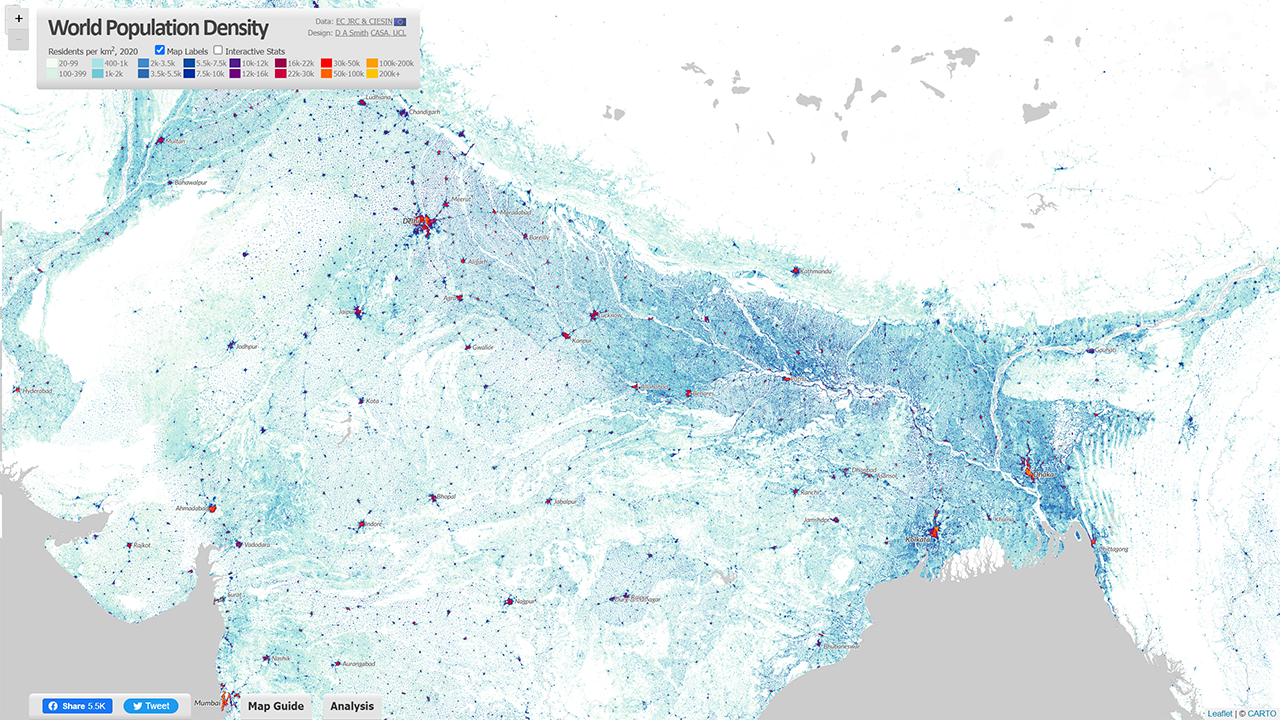
Improved Level of Detail for Cities and Rural Landscapes The new GHSL 2023 data has produced a much more detailed 10 metre dataset of built-up area (using recent European Space Agency Sentinel data), and this is the basis for creating the updated population layer. The results are much improved, particularly for complex rural and peri-urban landscapes in the Global South, such as for India shown below. The tens of thousands of small villages are identified and used to more accurately distribute India’s huge population. This is also the case for other key regions such as Sub-Saharan Africa, and China.
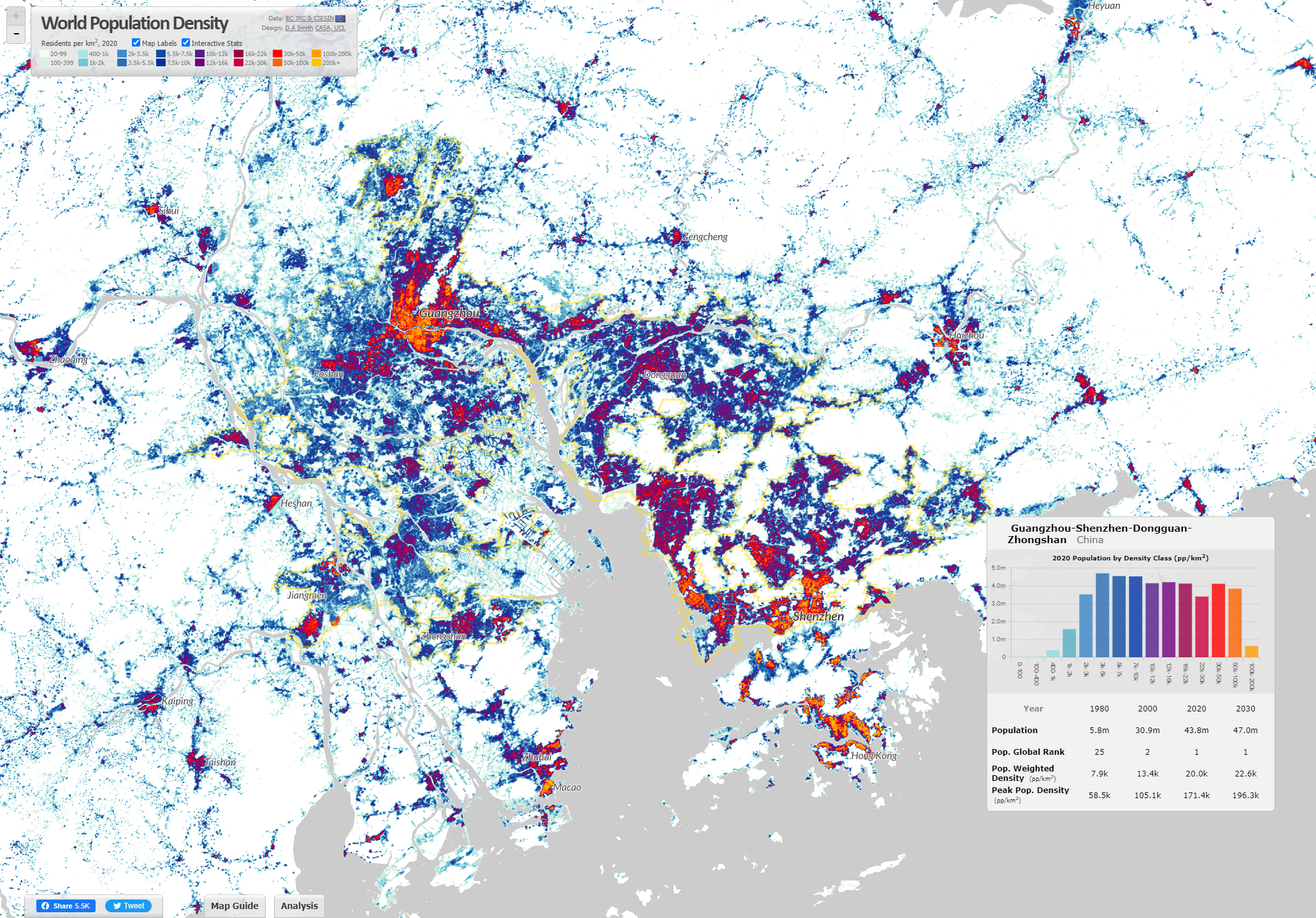
The added level of detail also improves the representation of cities, with more accurate density analysis, and improved techniques to differentiate residential from industrial and commercial urban land uses. Previous releases of the GHSL were underestimating urban densities for cities where census data was weaker, but this appears to no longer be the case. The dataset can now be used for more accurate comparisons of population and density for cities across the globe. Example images for Shanghai and New York City are shown below.
Country Density Profiles – the Diversity of Human Settlement The statistical analysis on the World Population Density Map website has also been updated using the 2023 GHSL data, so you can view the density profiles for all countries around the globe. Some highlights are shown below.
To complement the graph of the population in each density category, this updated version of the World Population Density Map includes Population Weighted Density statistics for each country and city. Population Weighted Density is a measure of the typical density experienced by residents in the country/city, in this case using the 1km2 scale GHSL data. The PWD is calculated by weighting each 1km2 cell according to the population, summing all the cells for the city/region, and then dividing the sum by the total population of the country/city (i.e. the arithmetic mean). This is a more representative measure than standard population density, which is affected by low density suburban/peri-urban and rural land, even where the population in these areas is relatively low.
China and India have very high density cities, but their large rural populations translate into moderate Population Weighted Density statistics overall. India is 9.9k pp/km2 and China is 8.9k pp/km2. The table below shows the top 20 countries by Population Weighted Density using the 2020 data-
Rank (by PWD 2020)
Country Name
Population Weighted Density 2020 (pp/km2)
1
Singapore
30.9k
2
Republic of Congo
25.2k
3
Somalia
24.1k
4
Egypt
21.8k
5
Comoros
17.4k
6
Djibouti
17.2k
7
Iran
16.8k
8
Yemen
16.7k
9
Jordan
15.8k
10
North Korea
14.8k
11
Democratic Republic of the Congo
14.2k
12
Bahrain
13.9k
13
Colombia
13.5k
14
Equatorial Guinea
13.5k
15
Turkey
13.5k
16
Morocco
13.4k
17
Bangladesh
13.3k
18
Taiwan
12.9k
19
South Korea
12.7k
20
Western Sahara
12.6k
For comparison, the equivalent Population Weighted Density figure for the UK is 4.1k, France is 3.7k and Germany is considerably lower at 2.7k. The USA is renowned for its low density living and suburban sprawl, and the Population Weighted Density measure for 2020 is 2.2k. This is the lowest figure for any large developed country in the world. Smaller developed countries have similar figures to the USA, including New Zealand, Norway and the Republic of Ireland.
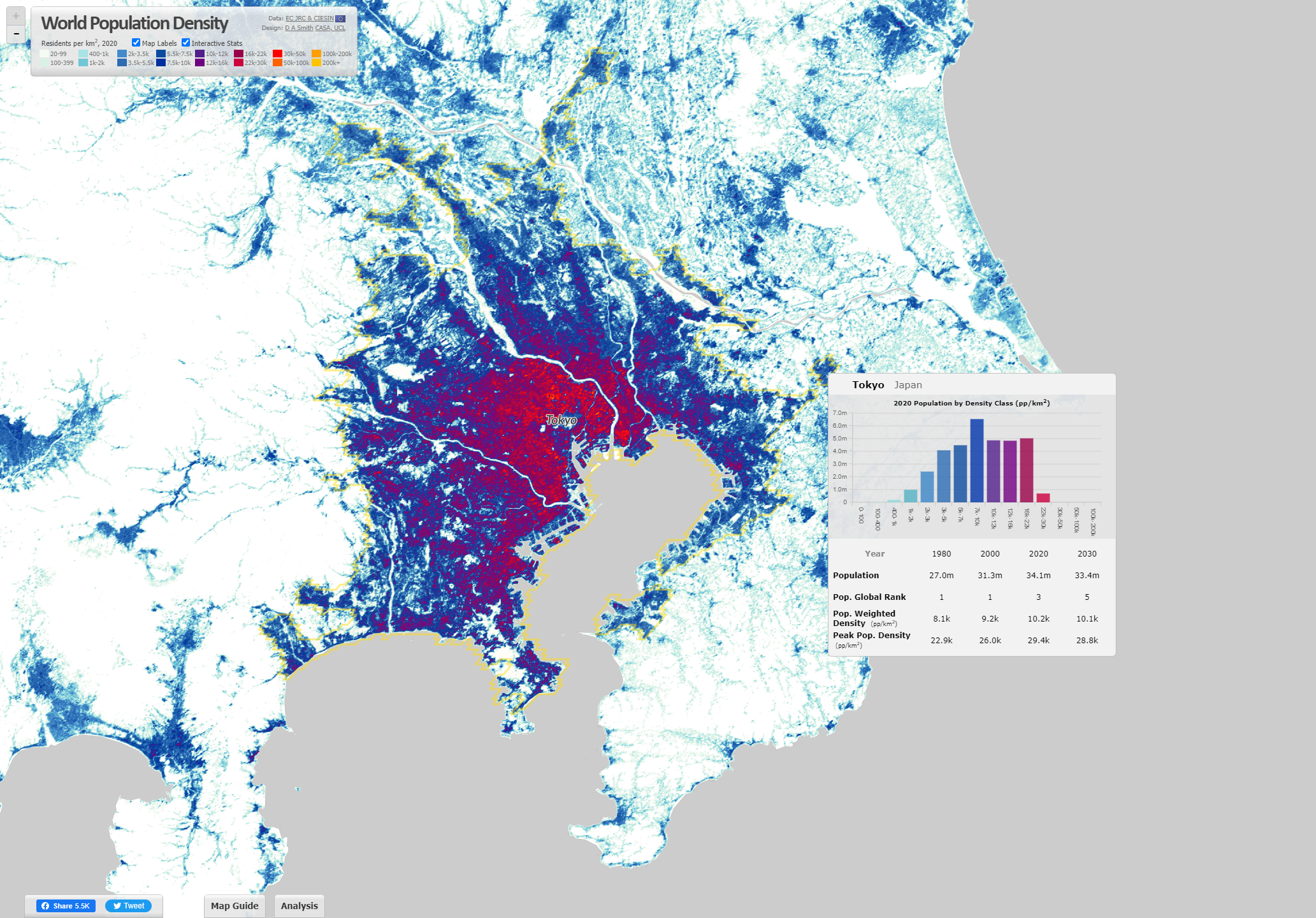
Analysing the World’s Largest City-Regions Using the GHSL The Built-Up Area and Population layers in the GHSL are used to define a settlement model (GHSL-SMOD) layer, which classifies land into urban and rural typologies. We can use this layer to define the boundaries of city-regions across the globe. This has been done using continuous areas of the highest urban category (urban centres) for the 2020 data. When you hover over cities on the World Population Density website, these city boundaries are highlighted-
This land use based method of defining city-regions produces different estimates of city populations to analyses based on administrative boundaries. The GHSL method generally emphasises large continuous urban regions, such as the megacity region of the ‘Greater Bay Area’ in China shown above, which has formed from the fusion of Guangzhou, Shenzhen, Dongguan and Jiangmen. This is the largest city-region in the world by this measure, with a population of 43.8m in 2020 (rapidly developing from a base of 5.8m in 1980). The top twenty city-regions in the world are shown below-
Rank (by Pop. 2020)
City-Region Name
Population 1980
Population 2000
Population 2020
Pop. Weighted Density 2020 (pp/km2)
1
Guangzhou-Shenzhen-Dongguan-Jiangmen
5.8m
30.9m
43.8m
20k
2
Jakarta
16.1m
26.3m
38.7m
13.4k
3
Tokyo
27m
31.3m
34.1m
10.2k
4
Delhi
8.3m
19.1m
30.3m
29k
5
Shanghai
6.7m
15.1m
27.8m
27.9k
6
Dhaka
6.2m
14.8m
26.8m
47.9k
7
Kolkata
16.3m
22.9m
26.7m
36.4k
8
Manila
11.3m
18.3m
24.8m
27.1k
9
Cairo
9.8m
16.6m
24.5m
44.9k
10
Mumbai
11.3m
18.4m
22.9m
52.4k
11
Seoul
13.3m
19.7m
22.7m
19.8k
12
São Paulo
13.7m
17.4m
19.7m
14.5k
13
Beijing
7.2m
11.6m
19m
20.2k
14
Karachi
5.8m
10.9m
18.7m
48.8k
15
Mexico City
13.8m
17.9m
17.8m
13.2k
16
Bangkok
5.4m
9.2m
17.4m
11.6k
17
Osaka
17.2m
16.8m
15.6m
8.1k
18
Moscow
9.9m
11.9m
14.9m
16.7k
19
Los Angeles
10m
13.1m
14.5m
4.6k
20
Istanbul
6.1m
10.4m
14.3m
25.2k
One of the most impressive aspects of the GHSL is that it is a timeseries dataset going back to 1975. Therefore we can create historical indicators such as the population change data shown in the table above. Many cities have more than doubled, or even tripled in population size since 1980, including Delhi, Shanghai, Dhaka and Karachi. Rates of growth in the USA, Japan and Europe are inevitably much lower, as seen in Tokyo and Los Angeles in the table above. Tokyo is often measured as the world’s largest city (for example in the UN World Urbanization Prospects), though with the GHSL method Tokyo the third largest at 34.1m in 2020. Tokyo is also distinctive in terms of its Population Weighted Density at 10.2k pp/km2. While this figure is more than double the density of Los Angeles, Tokyo’s medium density is much lower than cities in China and South Asia. Incredibly, Mumbai’s density figure is five times higher than Tokyo at 52.4k pp/km2, and Karachi is not far behind at 48.8k.
The pandemic and subsequent lockdowns have seen the largest and most sustained disruptions to travel behaviour in most of our lifetimes. Stay-at-home policies have fuelled a dramatic increase in remote working, and wider online substitution of other activities such as shopping and socialising. In sustainability terms, the pandemic has severely hit public transport and incentivised car travel, but has also likely reduced travel distances overall as well as encouraging new patterns in active travel. The big question is to what extent pandemic related changes are turning into longer term shifts in travel behaviour patterns.
This post looks at timeseries travel data across the last three years, and then summarises results from the recently published National Travel Survey data 2021 for England, with a particular focus on trip purpose and differences between London and England as a whole.
Transport Use Timeseries Data from DfT The Department for Transport have continually updated a very useful timeseries on how busy different transport modes have been in England throughout the pandemic. This index integrates many different datasets and is intended as a broad summary of trends (see methodology here). The graph below summarises this data, which is indexed to February 2020. The overall picture is of huge disruption in 2020, continued disruption with a transition towards recovery in 2021, and then what looks like settling into a new normal in 2022.
The chart paints a mixed picture in sustainability terms. Car travel has been the fastest transport mode to recover after each of the national lockdowns, and was back to near normal levels as early as summer 2021. While this is a challenge going forward, it could potentially have been worse. The pandemic could have resulted in substantial increases in car travel. Instead, there is a minor reduction to about 96% car use in the DfT data, sustained into 2022 (in per-capita terms this reduction will be more substantial given population increases). Note the motorised vehicle index that includes freight reaches 100% of pre-pandemic levels in 2022, possibly due to more online delivery traffic.
Public transport has been much slower to recover, falling to less than 50% of passenger numbers in 2020, increasing substantially throughout 2021 and then settling around 70-85% of pre-pandemic passenger numbers in 2022. Rail and tube travel were hardest hit in 2020 due to the widespread fall in commuting and these modes have taken longer to recover than bus travel. It is difficult to gauge whether public transport levels have now levelled off around the 75% level, or will continue to recover further in 2023 (the rail and tube strikes in summer 2022 may have curtailed further increases).
A positive sustainability story comes from the cycling data from the DfT. This is a less reliable metric, but nonetheless indicates growth in active travel, albeit from a low base in 2019. The annual variation in cycling in the DfT data between 2020 and 2022 is interesting. The initial 2020 increase in cycling makes sense, as there was a big growth in active travel for households locked down in their local area. This falls to 2019 levels in 2021, and then rebounds in 2022. Perhaps the fall off in new cyclists has given way to more practical longer term adoption of cycling in 2022.
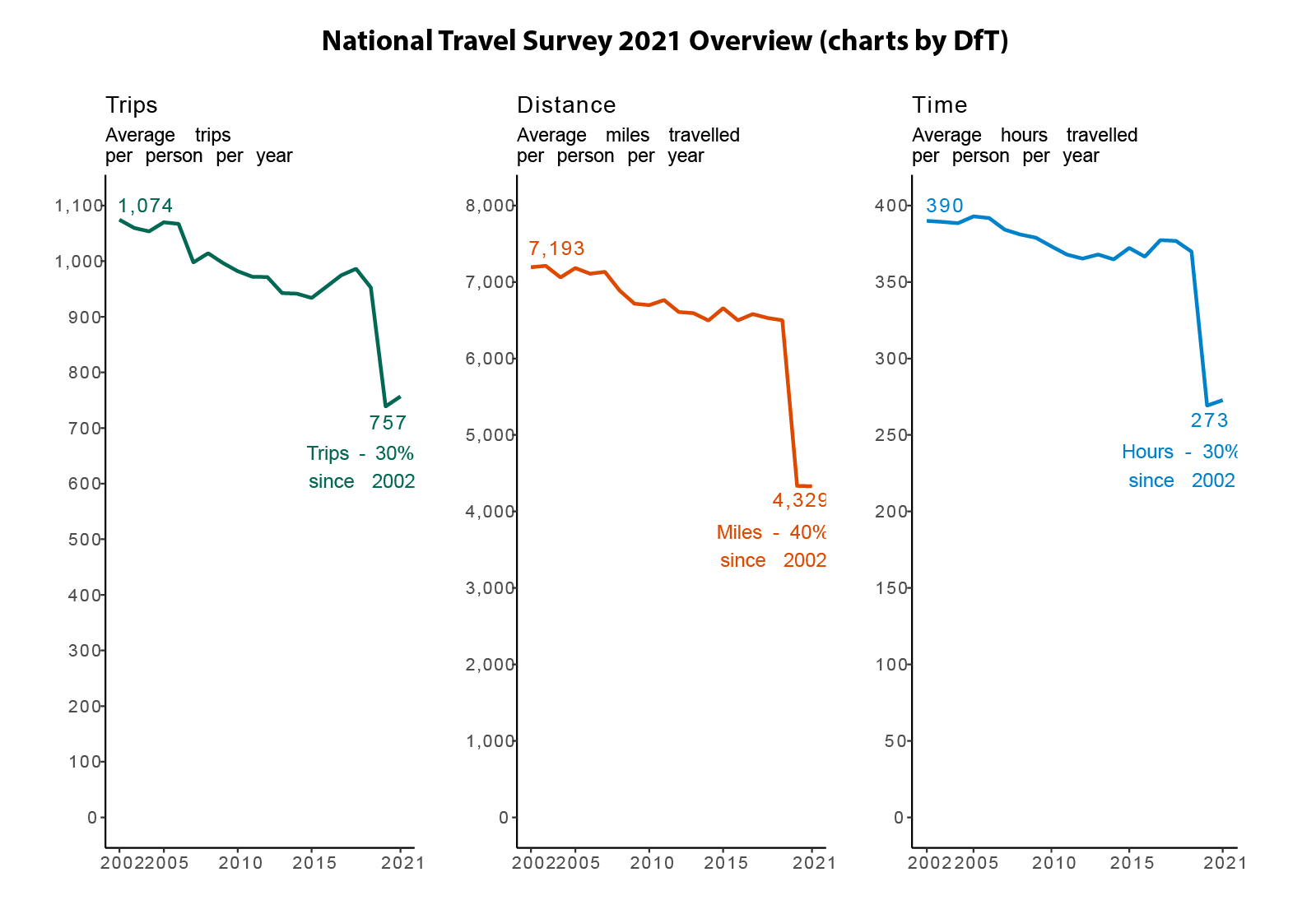
National Travel Survey Data 2021 The results for the National Travel Survey 2021 data were released at the end of August 2022. This long running survey records full travel diaries of thousands of residents in England, allowing analysis of topics such as trip purposes, walking trips and demographic analysis. There have been some data gathering challenges during the pandemic (see data quality report). The overall picture from the DfT chart below is that the 2021 NTS data is very similar to the 2020 data in terms of per person trips and annual distance recorded. This suggests that the NTS 2021 is not picking up much of the 2021 travel recovery that is shown in the DfT timeseries data we discussed above.
We can break down the annual trip distance per person by transport mode. The chart below compares the years 2019, 2020 and 2021. The results backs up the conclusion that, at the national level, the 2021 data is very similar to 2020. There is big reduction in car miles of 30%, while public transport levels are at around half the levels of 2019. There is a small increase in walking and cycling distances, though this falls back to 2019 levels in 2021.
Interestingly, the equivalent chart for London shows a very different picture in terms of travel behaviour responses. Car use increased marginally in 2020 (probably substituting for public transport trips) then falls in 2021, though this reduction is lower than the national picture. Bear in mind London mileages are around a third of the national average, so there may be fewer optional trips to cut. Meanwhile, public transport records a significant recovery in 2021 for rail and underground, much closer to the DfT time series analysis shown above (note the bus recovery is lower than expected). Walking and cycling follows the national picture by increasing in 2020 and then falling in 2021, though note that the 2021 cycling level is substantially up on the 2019 figure.
Overall the broad 2021 National Travel Survey results are fairly close to the 2020 results at the national level. In comparison to the DfT Transport use timeseries, it appears to be closer to the 2020 picture rather than the 2022 trend of a substantial recovery in transportation use. So we may have to wait for the National Travel Survey 2022 to confirm which changes are really sticking in terms of longer term behaviour. The London data is interesting, as it much more clearly shows a recovery in public transport travel in 2021, and a different picture for changes in car mileage, as well as a substantial increase in cycling.
Trip Purpose Analysis An important question is the type of trips most affected by the pandemic, and whether these changes are becoming longer term trends. The charts below show the trips per person per year and total distance per year between 2019 and 2021. As expected commuting is taking the biggest hit in terms of trips and distance, falling by 36% in distance terms and with only small signs of recovery in the 2021 NTS data. Drops in business travel are even larger, more than halving. Interestingly shopping trips have taken nearly as big a hit as commuting, with distances falling 26%. There has been a widespread trend towards online supermarket deliveries and online shopping more generally post-pandemic and it looks like this behaviour has continued into 2021. The 2021 NTS even shows shopping trips and distances falling again in 2021 from the 2020 level. Alongside commuting changes, shopping travel behaviour looks to be the major trip type that has been cut, possibly for the longer term.
Outside of commuting and shopping, other trip types with big reductions include holidays, business, and entertainment. In contrast day trips increased and walking trips nearly doubled (though both fell back marginally in 2021 from the 2020 peak). Visiting friends at their home also continued during the pandemic, with a more minor reduction in trips and distances.
Finally we repeat the distance trip purpose chart for London. Commuting takes an even bigger hit in London, falling by 48% in 2020, then moderately picking up in 2021. Business trips fell by a huge 67% and there is little sign of recovery. In contrast some trip types that declined in 2020 are nearly back at 2019 levels, such as education and education/other escort trips. The trips with the biggest increases in 2020, visiting friends at private homes and day trips, have also returned to their 2019 levels in the 2021 data. Walking trips have however remained considerably above their 2019 level, indicating that the active travel increase is looking more stable for London.
Summary
The DfT timeseries data shows travel patterns settling into a ‘new normal’ after more than two years of disruption. Car travel is only marginally down on pre-pandemic levels, while public transport is around 70-85% of the passenger numbers from 2019. There are some encouraging signs for active travel after increases in leisure walking and cycling trips, though the situation is dynamic.
The National Travel Survey 2021 data records a similar picture overall to 2020 in terms of major disruption- distances and trips down substantially. Car miles are down 30%, though the DfT timeseries data suggests this will not be the case in the 2022 data. Public transport remains around half of 2019 levels.
The trip types with the biggest reductions are commuting and business as expected, but also shopping (and the related travel type of personal business). Shopping trips fell again in 2021, and this looks, like commuting, to be a case of significant online substitution, possibly long term.
The London NTS data is very interesting, with some significant differences. Car use appears to have marginally increased in London in 2020, before falling in 2021 below 2019 levels. Public transport has staged a major comeback in London in the 2021 data, and there is also a sustained increase in cycling. The NTS data is also disaggregated into urban/rural categories and it would be interesting to test whether these trends are London specific or shared with other major English cities.















 CityGeographics