World City Living and Working Densities: Poles Apart?

One of the most recognisable visualisation techniques used by LSE Cities in the Urban Age publications is the 3D density map- an intuitive and engaging way to represent built form, and enable comparison of very different city environments across the globe. I’ve been producing 3D density maps in my own research for around five years now, and so it was a nice challenge to produce the 3D density maps for this year’s Urban Age conference, the Electric City in London. In this post I focus on the contrasting densities in three leading world cities- London, New York and Hong Kong- with the added twist that both residential and employment densities are mapped for comparison.

Higher urban densities can facilitate more sustainable travel patterns, improve service delivery efficiency, reduce building energy use and promote urban vitality. These advantages depend of course on good urban planning to minimise congestion and pollution problems. High density mixed-use development is central to the compact city planning movement, and remains a foundation of sustainable planning policy today. Here we map the number of residents in each square kilometre of a 100 by 100 kilometre region for London, New York and Hong Kong. Lower urban densities apply to suburban-like neighbourhoods, while high densities generally represent medium or high rise buildings clustered on a tight urban grid.

The city that stands out in the mapping is Hong Kong, with its extremely high residential densities exceeding 110,000 people per km2. Here planners have responded to scarce land availability with very tall (over 30 storeys) high-density development. Scarce land has also influenced the development of New York City, where Manhattan densities peak at 59,000 people per km2. London in comparison is much lower density. The heritage of suburban housing and generous greenspace has created a residential culture at half the density of New York and a quarter the density of Hong Kong. Despite current intensification in London, residential densities remain a world away from other global cities.

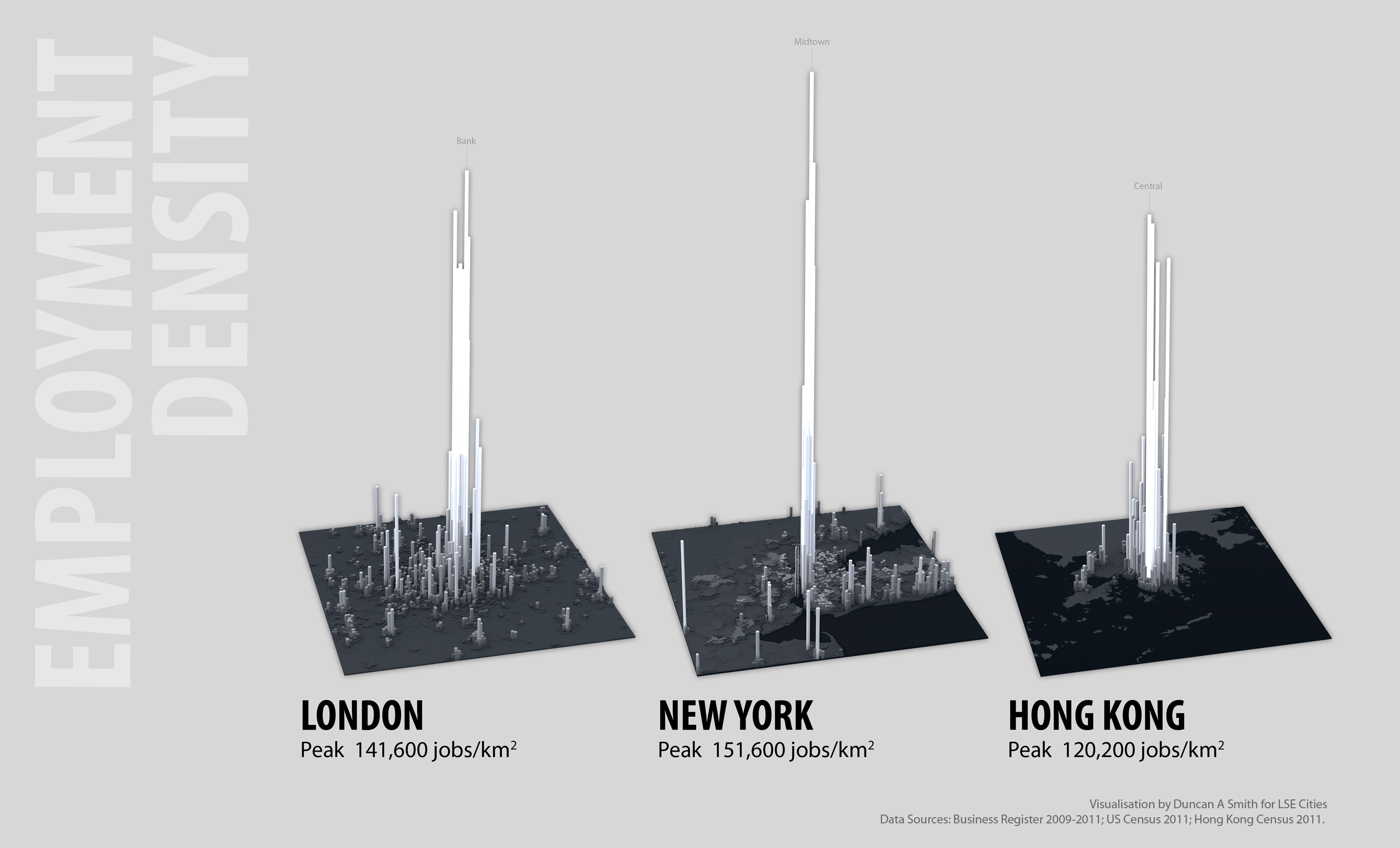
Where people live is not however the only perspective needed to understand urban density. We can also examine employment densities for an important point of comparison (both residential and employment maps are at the same scale). Taller spikes in the employment maps represent higher numbers of jobs concentrated in business centres. London, New York and Hong Kong feature very intensive central employment clusters. The highest peak of over 150,000 jobs per km2 is in Midtown Manhattan. London is surprisingly close behind at over 140,000 jobs per km2, concentrated in the City of London and the West End. Hong Kong peaks at 120,000 jobs per km2 in Central (note the Hong Kong survey data is less comprehensive and may underestimate peak densities). These intense spikes represent very strong agglomeration economies, where financial and business services and creative industries cluster together to access labour markets, share fast-changing information and engage in face-to-face interaction with clients, customers and partners. Despite living in an age of instant telecommunication, proximity is still critical for many world city business activities.

The extreme employment density peaks are indicative of economic success in these world cities. Demand for office space is so stong that developers get sufficient returns to build high and businesses use their space more intensively. Central employment clustering also means these cities are dominated by public transport rather than car travel (particularly Hong Kong). On the other hand the divergence of living and working densities can signify a lack of integration between living and working locations. London is very polarised between its low density living and high density working environments. This contributes to the long distance and long duration commuting travel for many Londoners (recent surveys find an average one-way commute times for Londoners of 38 minutes). New York has a better integration of living and working locations (average commutes are around 31 minutes). Hong Kong appears to have the closest integration of living and working spaces, though unfortunately commuting time survey data is not available to test this.

The analysis here supports the medium-rise inner-city residential intensification that the London Plan prescribes to improve the balance of urban functions, and increase accessibility for residents and businesses. The gap in residential densities between London and many world cities is so large that modest intensification can be achieved while keeping London’s distinct character, providing development is on the much remaining brownfield land rather than London’s treasured greenspaces.

Another interesting thought is whether the highly concentrated office clusters we see in London and New York will continue to be the way most businesses operate in the future. Greg Lindsay gave a good talk last week on how businesses are changing the way they use work space towards more shared and flexible environments that will likely be less space demanding.

To see more detailed analysis of sustainability trends in many more world cities from the Urban Age conference see the Electric City conference newspaper.

Sparks of Inspiration at the Electric City Conference

UAECC_7Dec_103
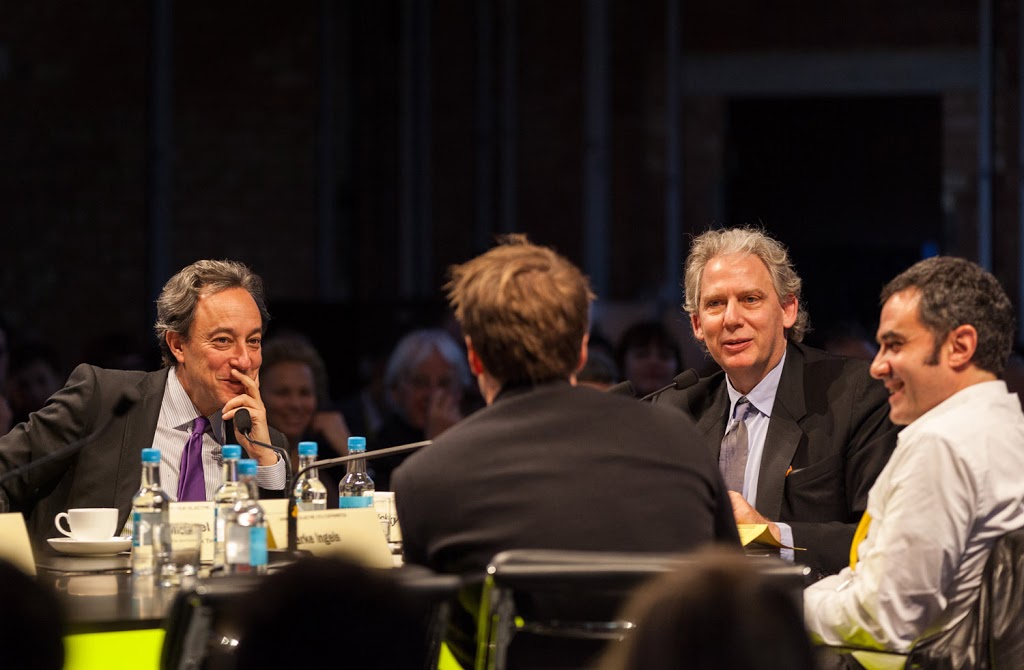
Michael Kimmelman, Bjarke Ingels, Ricky Burdett and Alejandro Zaera-Polo debate urban design

You know you’ve attended a good conference when the discussion leaves your head buzzing with new ideas and possibilities, and the debate continues long after the event closes. This was certainly the case at the Urban Age Electric City conference last week, where politicians, academics, designers and technologists met to share, discuss and argue urban policy and the future of cities.

Ostensibly the conference theme was smart cities and urban technology, and there were several tech business speakers extolling the virtues of electric cars, smart grids and so on. There was however widespread cynicism of techno-fixes on many fronts. Adam Greenfield used the very definitions of the smart city provided by corporate promoters to show the vacuous techno-utopian branding of what is often simply an extension of the real-estate industry. Richard Sennett articulated the ambiguous and complex nature of traditional street-based urban form, and by extension how archetypal smart-city examples from Masdar and Songdu failed to create similar spaces of social interaction that support innovation.

Yet it must be said that the urban technology debate is itself far more diverse than the strawman examples of Masdar and Songdu. Certainly the Shoreditch digital economy cluster that surrounds the conference venue illustrates thriving tech businesses in a traditional urban setting. Many of the counterexamples to smart-city utopia presented during the conference themselves involved aspects of technology, particularly in relation to communication and participation.

Urban equity, or lack of, was a key theme for many speakers. Enrique Peñalosa, former mayor of Bogotá, passionately argued for tackling social inequality as a central element of improving urban sustainability- an argument he has helped translate into reality through reforming Bogotá’s public transport networks. The politics of inequality also underlie the social movements and protests that have rocked the world, from Occupy to the Arab Spring and the London riots. In these cases social networking technology presents a highly dynamic and unpredictable force that city governments, both rich and poor, are struggling to engage with.

On the design front, the talk that best integrated the conference themes was from Alejandro Zaera-Polo, who sought to articulate the evolution of architectural style and practice in response to digital communication. Citing modular and self-build architecture examples, he described a new aesthetic of incompleteness, and used slum developments as the model of how complex functional urban form emerges from simple building blocks. He also pointed to crowdsourcing as an increasingly key funding mechanism for development in the austerity age, requiring a new entrepreneurialism from architects to generate public support and money for ambitious projects. This spirit of architectural daring and entrepreneurialism was certainly on show from Bjarke Ingels, whose mad and wonderful “hedonistic sustainability” examples were a joy to see.

Alejandro Zaera-Polo- "architects must create belief"
Alejandro Zaera-Polo- “architects must create belief”

Yet as much the designers inspired, presentations tackling the global environment highlighted the gaping chasm between urban sustainability aspirations and reality. “Cities dream of Barcelona and build Los Angeles” was Greg Clark’s quick-fire summary of Joan Clos’s conclusions from the UN Human Settlements Programme. “The compact city plus global lives do not equal sustainability” correctly argued Maartin Hajer.

Intellectual heavyweight Anthony Giddens grappled with the grave implications of the 4+ degrees warming path we are set on for this century, and the high-risk high-opportunity civilisation we have created. When asked somewhat glibly by the chair whether he was an “optimist or a pessimist” he replied quite rightly that the question was irrelevant and that climate change requires scientific realism, a perspective that is currently beyond much of the public. It’s certainly appeared beyond the UK politicians on show, who enthusiastically banged the drum for sustainable London while conveniently forgetting that much of the globe’s fossil fuel industry in headquartered in London and funded by City banks.

Anthony Giddens tackles the implications of global climate change

There were also some rays of hope for a deeper understanding of urban sustainability. The former mayor of Stockholm, Carl Cederschiöld, described how sustainability progress had been achieved in his city, pointing to the vital role of both strong national support and public understanding as well as city government. Dimitri Zenghelis put forward the economic growth case for an urban green transformation. Mark Swilling presented a methodology of understanding urban sustainability through social and resource flows- exactly the kind of approach needed for considering sustainability in an age of global connectivity. Maartin Hajer described the need for forging “coalitions of the willing” in tackling global sustainability where international governance has been so ineffective.

And that’s what the Urban Age conference surely is in the end, one big coalition of the willing… or willing to discuss and debate at any rate. Thanks to all those who took part and contributed to a very engaging event. If you missed it, conference video highlights will be appearing on the website over the coming days, and you can read essays by many of these speakers in the conference newspaper.

Urban Age Electric City Conference

ElectricCity

I recently began a new job at LSE Cities and have been working for the last month on materials for the Electric City conference in London, taking place on the 6th and 7th December this week. The conference will be exploring smart cities and disruptive urban tech from a sociological slant, and includes talks from famous urbanists such as Ed Glaeser, Saskia Sassen and Deyan Sudjic. You can get a flavour of the debate from Richard Sennett’s provocative article on “Stupefying Smart Cities”.

The whole event will be live streamed on the conference website.

My role, alongside the LSE Cities Research Team, has been in producing comparative urban visualisations and analysis around the theme of sustainable urbanism. These visuals and articles are now online in the conference newspaper.

Copenhagen and Hong Kong: Mapping Global Leaders in Green Transport

Cities that achieve social and economic success without high car use generally have three things in common: high densities, good urban design, and successful planning frameworks that integrate land-use with public transport, walking and cycling networks. I’ve been working on an LSE Cities project that investigated two leading global cities in green transport- Copenhagen and Hong Kong- to better understand how their leading positions were reached. You can read the final Going Green report here.

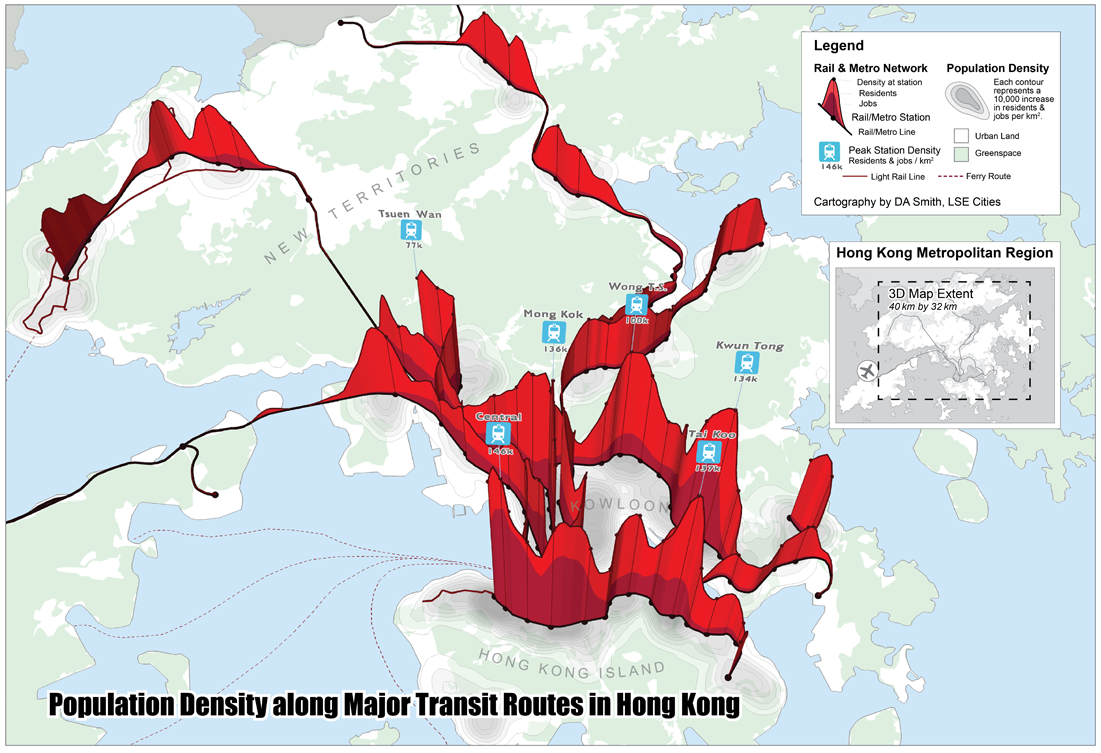
The project required visualising the level of integration between public transport and urban density in these cities. We developed a technique where the rail network is shown as a transect through a 3D population density surface. This shows how the density of jobs and residents in these cities is clustered around major public transport nodes.

CopenhagenMap_small

Copenhagen has a classic radial pattern, based on the famous ‘Finger Plan‘ developed over 60 years ago, where linear urban features are separated by thin green wedges. This is quite distinct to the UK greenbelt approach. Current expansion is focussed to the south of the city centre along the Orestad corridor served by the more recently developed metro links. This area sites the airport and transport links to Sweden, continuing the cross-border integration between Copenhagen and Malmö.

Hong Kong makes a very interesting comparison. It is on average 8 times(!) higher density than Copenhagen, and peak densities are around four times higher at nearly 150,000 jobs & residents per square kilometre. This is due firstly to the natural boundaries and country park designations that prevent suburban development, and secondly to the unique ‘Rail plus Property’ planning model run by the government and MTR, where extremely high development densities are pursued at rail station sites, and land value gains captured to fund public transport. The result is a polycentric pattern of jagged nodal development.

HongKongMap_small

Another way to consider this relationship is to measure typical distances to rail & metro stations for these cities. As can be seen below, Copenhagen and Hong Kong compare favourably to other leading global cities like London and New York.

It would be interesting to pursue this analysis further for London. You can see that London scores relatively lower for the population within 500 metres of stations. Intensification policies at public transport nodes are a recent policy change for London. Accessibility figures are likely to change over time with several major intensification projects under way at rail stations in Inner London.

(Above figure based on metropolitan regions. Defined as Outer Met Area for London and 100 km by 100 km square centred on Manhattan for NYC).

Carbonchart: Why are Global CO2 Emissions Soaring?

As the costs of recent droughts spiral from USA to Australia, West Africa to India, we’re getting a taste of what a significantly warmer climate would be like. Critically as the scientific evidence mounts up that climate change is occurring, global carbon dioxide emissions are soaring. Why is this?

I’ve designed a new website Carbon Chart visualising current data to answer this question.

There’s no single ideal metric to determine the contribution of different countries towards global warming, and a range of different perspectives need to be considered, as well as related issues of economic development and poverty reduction. The design of Carbon Chart is intended to allow the comparison of several perspectives.

So where are the maps? I’ve gone for a graph approach to focus on change over time. See Kiln’s excellent Carbon Map website for a cartogram-based approach to understanding global warming.

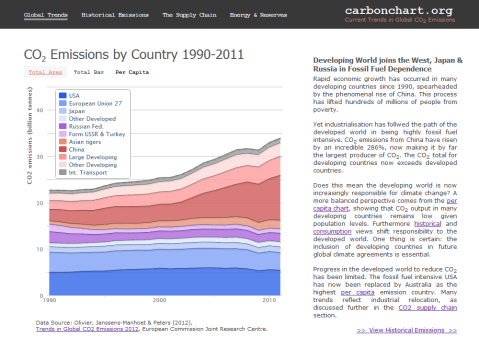
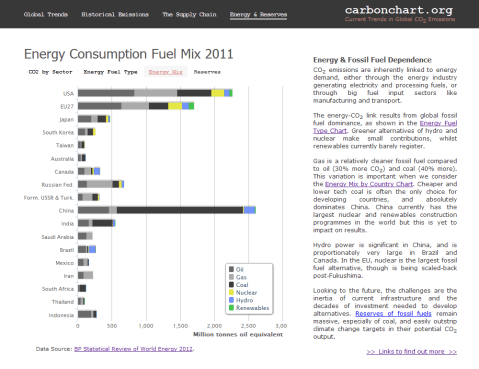
Current emissions data do not make happy reading. CO2 output is increasing in the developed world in consumption terms, and is rocketing in the developing world, especially China. We’re replicating our carbon intensive economic model on an incredible scale.

Maybe the climate models are wrong, or maybe an international climate agreement with substance is just around the corner. But right now it’s difficult to see how the more extreme scenarios of 4°C+ warming are going to be avoided.


Automobile 2.0: Electrification, Sharing and Self-Drive

Autonomous car concept by Mike and Maaike.


Despite the litany of sins levelled at the automobile- it’s woeful energy efficiency, harmful pollution, congestion, road casualties, damage to public space, contribution to obesity- we are still wedded to the car. In the UK the car accounts for over three quarters of trip miles. The flexibility, security and door-to-door convenience of automobile travel remains a winning combination, particularly when we spent most of the 20th century developing car-based cities with limited alternatives.

Current planning practice restricts car travel to improve sustainability and urban quality of life. Short of an outright ban however, the car is here to stay in some form or other.

For the automobile to be in any way sustainable we need to radically challenge current systems of car design, driving and ownership to effectively create a new mode of transport. This post considers whether such a revolution is possible in light of exciting recent innovations.

Electrification
We now for the first time have competitive alternatives to the internal combustion engine car on the market with electric and hybrid models from the world’s biggest manufacturers. These technologies dramatically reduce or remove tail-pipe emissions. Surely then the eco-car has now arrived and city transport has been saved?

Nissan Leaf plugport


Well… as electric cars (and vans/taxis/buses) become more widespread urban air quality should improve dramatically, as should vehicle mileages. But as we generate the majority of electricity using fossil fuels (and will continue to do so for the next 20 years+), CO2 emissions from electric cars remain significant.

Furthermore several other car design issues are not solved by electrification, such as energy used in manufacture, road congestion, safety and damage to public space. There’s a danger that electric cars become merely a green-wash cover for business as usual, rather than as a step towards bigger change.

Sharing
Most cars are driven for a relatively short period each day, and are parked the rest of the time occupying land (around 10% in cities). On-street parking eats up large amounts of valuable public space from pedestrians, public transport and cyclists. It’s a wasteful situation, both for the efficiency of cities and for the environment due to the vast amounts of materials and energy used to manufacture our largely idle cars.

One increasingly popular solution in cities is car-sharing, with the largest company Zipcar now up to 700,000 members. Car-sharing is a convenient and affordable option for many city residents who want regular car access without the hassles of ownership. The popularity of smartphones provides an easy way to manage car-share booking. Comparable sharing trends are also evident for ride-sharing and for urban cycling.

Is sharing the answer then to the sustainable city travel? It’s definitely an important trend. Sharing allows a much better pricing model for driving, paying by the mile and charging more at peak times, thus encouraging more efficient behaviour.

Car-sharing coverage is limited however to denser urban areas, and it is not yet clear to what extent car-sharing can significantly reduce the total number of vehicles and car parking space in cities.

Self-Drive
The last trend is at a much earlier stage than electrification and car-sharing, yet it could have the most far-reaching consequences. Sat-nav and parking-assist technologies were early steps towards greater automation in cars. Now Google as well as several manufactures have working prototypes of autonomous or self-driving vehicles.

Amazing yes, but what’s the point? In its current form, the application of this technology is not immediately clear, beyond providing a luxury car gizmo that lets you read the paper while your car drives you to work. But future developments will likely involve cars built around self-drive from the ground-up.

Potentially you could have a city taxi fleet of fully autonomous electric cars, requested by smartphone, operating 24 hours a day, moving to areas of high demand, charging batteries when not in use. Whilst bad news for taxi-drivers, such a system could be highly efficient and provide a quick and flexible complement to mass transit networks.

A related concept has already been developed in a rail-pod form operating at Heathrow airport. Dubbed Personal Rapid Transit, it is intended to combine the advantages of both private and public transport. Obviously the challenges of converting such a system to operate autonomously in the ‘wild’ of the urban environment are many, yet are increasingly being tackled.

If such a system could safely and legally operate, the implications would be massive. Imagine freight and courier services operating automatically at night to minimise disruption; your car picking up your shopping on its own, or taking a nap and waking up at your destination.

Reality Check
It’s easy to get carried away with the wonders of new technology. Transport challenges require political and economic solutions as much as technological brilliance. Indeed relying on car manufacturers alone to green transport is as unlikely as “Beyond Petroleum” BP and Shell delivering the renewable energy revolution. Yet there is some incredible innovation currently emerging, and the next couple of decades are certain to be very interesting times for urban transport.


A Tale of Tech City: the future of Inner East London’s Digital Economy

Earlier this month Demos published a fascinating report on the hot topic of London’s “Tech City” cluster, which has been promoted by the government as a key growth pole for the UK. The report authors Max Nathan, Emma Vandore and Rob Whitehead, put the Inner East London cluster in the context of similar phenomena in New York and Berlin; and get their hands dirty with some in-depth data analysis and face-to-face interviews of entrepreneurs. Policy recommendations are then made for the best way forward.

There have been some cool efforts at mapping the Silicon Roundabout Shoreditch/Old Street cluster from Wired UK, and from Tech City Map using social networking connections. A more traditional robust approach was taken in this report of using the various business survey datasets to measure firms and their activities. The scale of the cluster (defined more widely to include Clerkenwell, Shoreditch and Hoxton) was found to be larger than previously thought, at around 3,200 digital economy firms and 48,000 jobs, with these industries becoming increasingly important for the London economy.

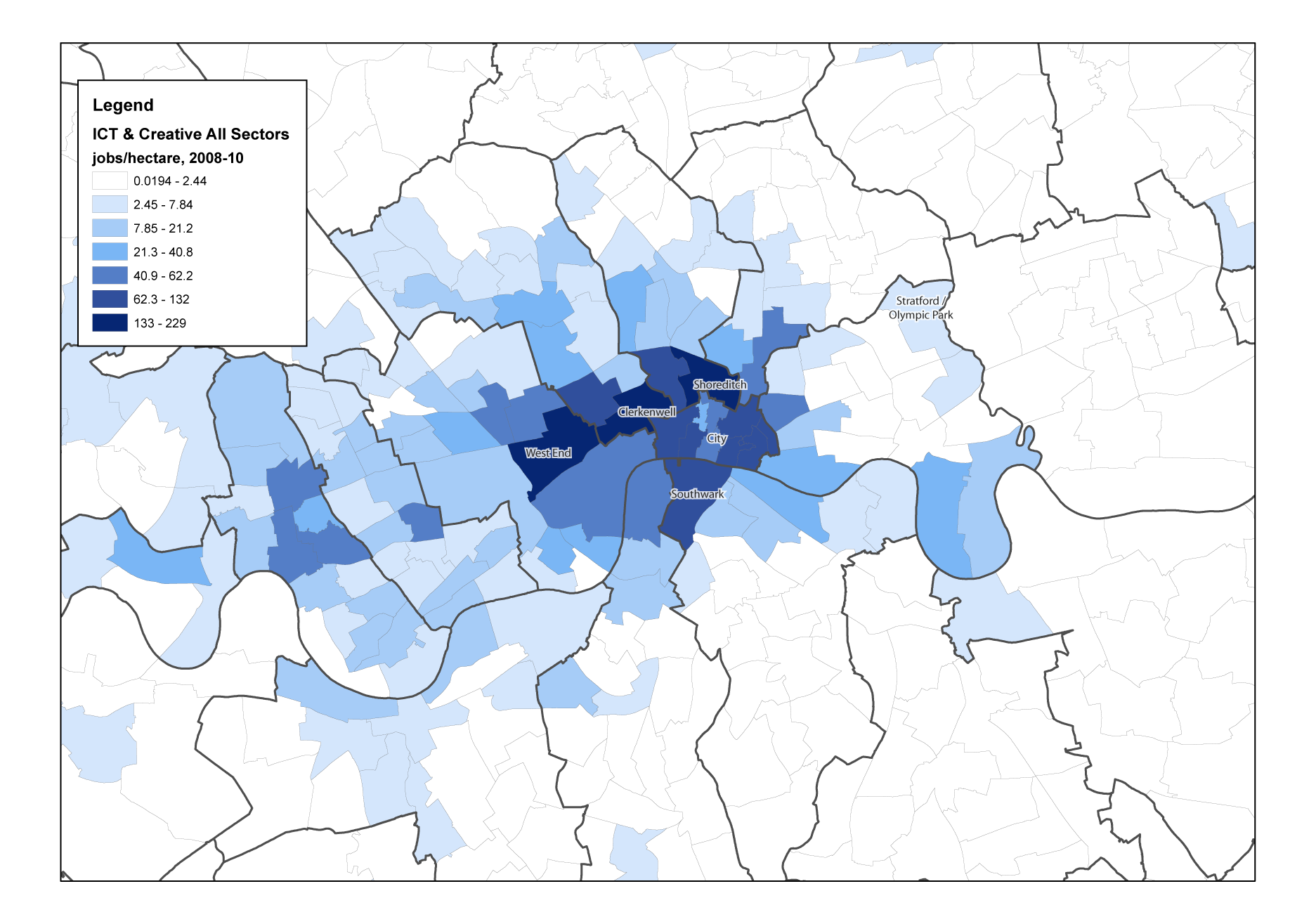
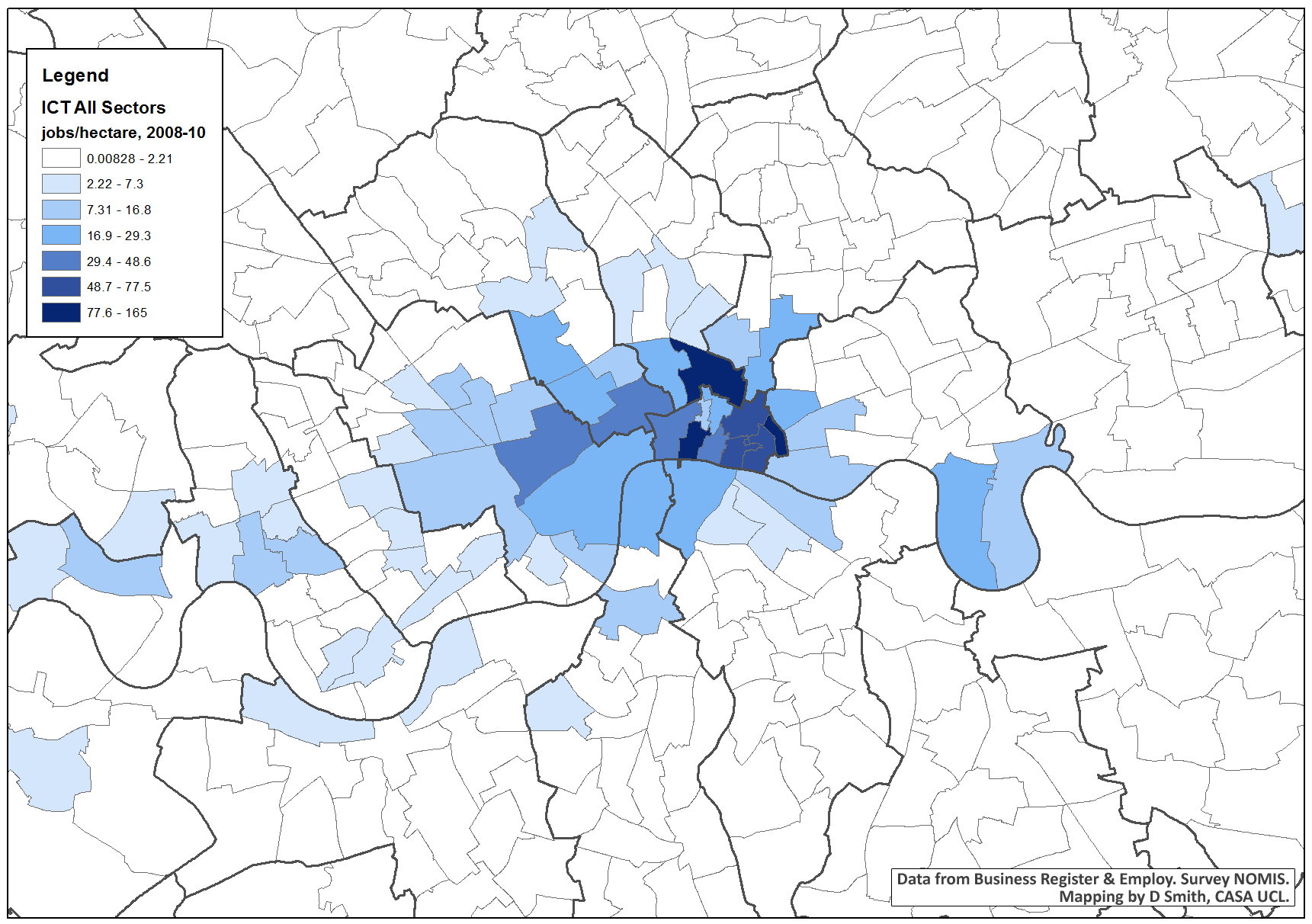
I got involved with the project doing some density mapping of the core industries that make up the cluster: ICT firms and creative industry firms. The key message that comes from such mapping is that the cluster is embedded in a digital-creative corridor stretching from the West-End and Soho through Clerkenwell and on to Shoreditch.

From a spatial perspective, the cluster is about the Jane Jacobs type urban diversity fusion of IT and creative industries, very similar to Silicon Alley in NYC. High profile success stories like LastFM (music, digital broadcasting and social networking crossover) and Unruly Media (advertising, social network and analytics crossover) are prime examples of this integration. This tech-creative fusion clearly distinguishes the Inner London cluster from the IT software/hardware concentrations you get in Silicon Valley, or in the “Western Wedge” around Heathrow.

A high profile policy objective from the UK government has been to link the Inner East London cluster to future opportunities at the Olympic Park. The Demos report convincingly argues that the focus should rather be on the current cluster, enhancing funding opportunities, skills and growing new businesses. Moving to the Olympic Park is problematic in terms of it lacking the history, creativity and ‘vibe’ of the current cluster. The absence of creative and IT firms around Stratford is apparent in the above maps. Opportunities in the Olympic Park are more likely to suit larger established IT and engineering firms attracted to new high-spec offices.

That’s not to say the Olympic Park can’t have a role however. The firm interviews in the Demos report identified the lack of skilled workers being a big issue, at all levels including graduates:

There just aren’t enough computer scientists in the uk. And we need computer scientists, we don’t need – what do they call it – ICT trained people. We need real computer scientists who do software engineering and programming. No education coupled with visa restrictions is not a particularly good combination.

So apart from lifting the current counter-productive visa restrictions in the UK, there’s a clear role for universities in training more computer scientists with the right skills to succeed in these growing industries. This is what London universities are now in the process of doing at the Olympic Park, with new campuses planned and initiatives such as the UCL-Imperial smart cities institute in the pipeline. Your very own CASA is already involved in training graduates with smart cities skills. Smart Cities industries can themselves be viewed as a built environment-engineering-ICT fusion, likely complimentary to creative industry clusters.


Visualising Flows 2: the Global CO2 Emissions Supply Chain

GlobalCarbonFlows_web

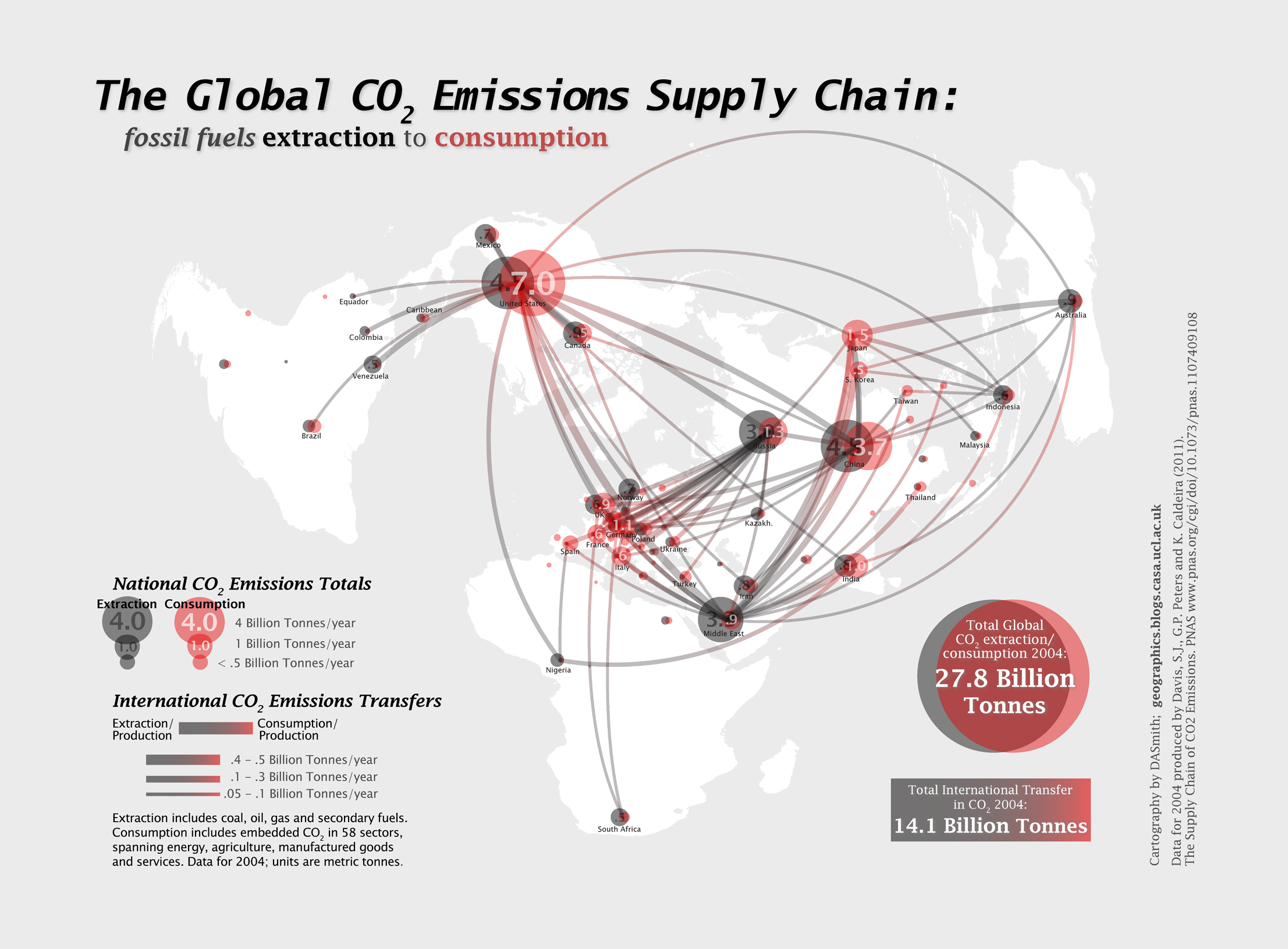
Every so often you come across a dataset that really amazes you in its richness and ability to change perspectives on understanding the world. One such dataset has been produced by academics at Stanford and Oslo tracing the global supply chain of CO2 emissions.

Traditionally emissions are attributed to countries depending on where fuels are burned- the point of production. This approach puts big industrial polluters like China at the top of the emissions pile. Yet globalisation means that we are linked into an increasingly complex web of trade that challenges a production-based understanding of emissions. A quarter of fossil fuel CO2 emissions can be considered as being embedded in manufactured goods that are consumed away from the point of production.

To address this issue Davis, Peters & Caldeira have created a database charting the global supply chain of CO2 emissions from extraction to production and finally to consumption. The database covers coal, oil, gas and secondary fuels traded by 58 industrial sectors in 112 countries for the year 2004. Even better, the entire database is available online.

Maps of the major carbon transfers included in the paper highlight firstly the massive flows from the energy rich Middle East and Russia, and secondly how production emissions from industrial countries such as China are ultimately driven by consumption in the affluent core of USA, Europe and Japan.

Davisetal_FlowMap

Being a mapping type, I feel that the flow maps in the paper miss out much of the amazing detail in the dataset, such as extraction to consumption flows within countries (half of all emissions). So I decided to put my visualisation skills to the test…

First up I produced a proportional bubble map of extraction and production, giving a good sense of the relative scale between countries. Economies with high levels of both extraction and consumption (e.g. USA and China) exploit their own energy resources and have large emission flows within their national boundaries. Other large consuming nations that lack energy resources (e.g. the EU,  Japan and South Korea) must import them.

GlobalCarbonBubble_web

Next I mapped the transfers of CO2 embedded in trade flows, using the same black-red colour scheme to indicate flow direction. While the visualisation is not as straightforward as the simpler flow map above, it gives a strong sense of the amazing complexity in global trade relationships and highlights clear patterns and structures.

GlobalCarbonFlows_web

Black lines emanate from the major energy exporters of the Middle East and Russia. Indeed the degree to which all of Europe is dependent on Russian energy is highly alarming. Major industrial countries act as intermediaries, both importing and exporting emissions. For instance China and Japan import energy and materials from the Middle East, Indonesia and Australia, then export manufactured products to the USA and Europe. The USA is top predator in the emissions food chain, spectacularly drawing in goods and resources from every corner of the globe and racking up over 25% of global emissions by consumption.

The data is for 2004, so some current trends like the strong growth of South America, continued growth of China and the strengthening relationships between China and Africa are not fully captured. Hopefully an update will come in the not too distant future.

On the cartography side, I went for the Azimuthal Equidistant projection to emphasise the close North America-Europe-Asia links. This projection is recognisable as the basis of the United Nations logo. Here however it is global capitalism and environmental exploitation drawing the world together like some kind of tightening noose. After another empty environmental conference at Rio+20, burning billions of tonnes of fossil fuels is set to remain a defining characteristic of our age.

Visualising Flows: Great Britain Journey-to-Work

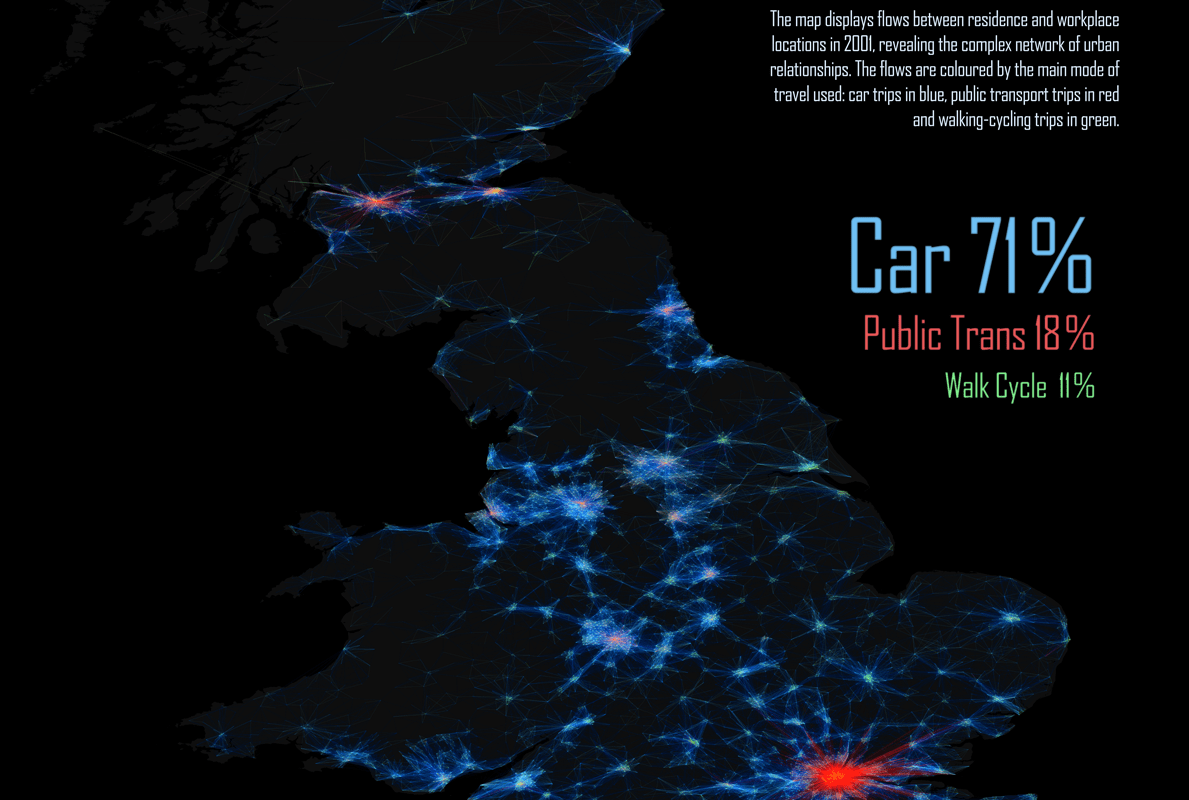
There have been some wonderful flow maps appearing online recently, such as Paul Butler’s global facebook friend’s map, and maps of global trade and flight patterns. Inspired by these, I’ve been mapping travel patterns in Great Britain using a similar “night-lights” visual style.

The above maps use data from the UK census connecting where people live to where they work, showing how transport flows form complex urban networks and extensive metropolitan regions. The data is at ward level, allowing a good level of detail:

EW_commuter_flows

Taking this visualisation further, a key issue for policy makers is how people travel, with private cars having greater energy, pollution and congestion impacts than alternatives. The final map below groups work trips into car, public transport and walking-cycling travel using an RGB colour scheme, creating a galactic effect (click for larger):

The aim of the visualisation is to put travel patterns in the context of the diverse urban scale and geography of Great Britain, and reveal the degree of regional variation.

The map really highlights how different London is in terms of its extensive regional public transport network, with the other major English conurbations like the West Midlands, Manchester and West Yorkshire being highly car dominant in comparison. The variation in public transport levels could be argued to relate to London’s massive size, yet the Scottish cities of Glasgow and Edinburgh perform well in public transport terms, despite being smaller than England’s northern cities.

Active travel modes of walking and cycling are generally minimal. The cities that do relatively well are the “cathedral cities” like Cambridge and York, with a few surprises like Hull.

The maps were created in ArcGIS using the XY to Line tool, then exported to Illustrator. A key aspect of such flow visualisations is that the thousands of overlapping flows add together to form denser links using a cumulative transparency effect. This is much easier to achieve using a vector graphics program such as Illustrator. Would be nice in a future post to add Northern Ireland and the Republic, and will get a data update with the 2011 census next year.

BBC London Calling Season


To mark the Olympic year a series of programs on London is being broadcast by the BBC, exploring the dynamic and diverse nature of the capital and its historic roots. There have already been some great documentaries on, with interesting use of maps, archive materials and personal testimonies charting the changing city and built-environment.

Last night saw the start of The Secret History of Our Streets, telling London’s history in microcosm by picking one street to follow in each episode through good times and bad. The first episode told the rather tragic tale of Deptford High Street, which moved from a relatively thriving working class centre in the early 20th century to one of London’s poorest areas in the present.

A shop trader John Price (below) who has lived in Deptford all his life engagingly recounts the close community life of his youth with his extended family all living on the same street. This is brought to an end with the drawn out demolition of the Victorian terraced housing to be replaced by modern estates. The existing community is separated as families move out to suburban new towns.

Modernist planning is unashamedly painted as the bad guy in this narrative. “Tell ’em the truth, tell ’em how they fucked everything up” mutters a passerby in one scene. The father of British Planning, Patrick Abercrombie, appears as a monocled toff in the archive footage, as he expresses his disgust at London’s old housing. This critical view of planning intervention is clearly simplistic, as there were of course very severe housing problems in London.

Yet the filmmakers back up their perspective by uncovering the council’s environmental health archives, showing that John Price’s street was healthy and in a decent state of repair- not the slum that it was labelled. To add salt to this wound, such traditional housing is now in great demand in Deptford and Greenwich, with terraces on nearby streets selling for well over half a million pounds, in stark contrast to the drab and inflexible modernist housing that replaced it and cannot be gentrified. The forthcoming episodes in this series will likely tell more rosy tales of changing London, but Deptford’s history was hard hitting stuff and very well told.

Continuing on the traditional market theme, the BBC has also been exploring London’s remaining wholesale markets in The London Markets. These have moved out of the city centre for cheaper rents and road transport links, with Billingsgate fish market moving to Docklands and Covent Garden fruit and veg going to Vauxhall. Smithfield meat market is still hanging on near the City, but surely not for long. The arcane night-time world of the butchers appears as a weird anachronism surrounded by late night financiers and clubbers in Farringdon.

Lastly on a lighter note, A Picture of London explored artists interpretations of the city across time. As well as picture postcard views from Canaletto and Monet, some of London’s most dramatic moments are depicted such as the burning of the Houses of Parliament by Turner. My personal favourite however was this gem from the archives of a witty and prescient silent movie from the 1920’s of a time traveller guessing what London might be like in the future. Perhaps the oldest urban sci-fi film? Take a look:

Applied Urban Modelling 2012

CASA researchers were out in force at the AUM 2012 meeting in Cambridge last week, organised by the urban modelling group at the Martin Centre. It was an enjoyable meeting, with a good range of participants from both academia and built-environment practitioners. I’ll discuss some highlights from my own GIS and visualisation perspective.

It was great to see Paul Waddell present UrbanSim, which is a well established and popular open source platform for land use transport modelling based on microsimulation. Current improvements include adding 3D visualisation capabilities and pedestrian accessibility. Paul also had a demo of an impressive new urban design tool using a procedural architecture approach similar to CityEngine. Colleagues at CASA Camilo Vargas and Melanie Bosredon are developing an UrbanSim model of London, so we will be returning to this software in future posts.

Andres Sevtsuk from City Form Lab MIT presented on modelling retail locations from a street network Space Syntax type approach. His team have developed an Urban Network Analysis tool for performing measures like Betweeness and Closeness within ArcGIS. This tool is also open source and it’s great to see so much interesting software going down this free to access route.

My favourite presentation was from past and present CASA researchers Kiril Stanilov and Paolo Mascucci. Kiril has painstakingly been putting together an incredibly detailed vector dataset of the growth of London’s road network from the 1700’s to the present day. The time-lapse sequence of the network growing looked spectacular, highlighting the path dependence from historical forms and the different sequences of growth in London’s history. There’s fantastic potential in this dataset for improving modelling and understanding of how cities grow and develop. A flavour of the data can be seen in the below poster image:

Mapping Intra-metropolitan Journey-to-work Sustainability


As cities expand with multiple centres spread over massive regional hinterlands, the need to better understand the geographical variation across and within cities has become more pressing. This need applies strongly to issues of travel sustainability, where urban centres differ greatly in the accessibility they facilitate for private, public and active transport.

Spatial indicators are a useful tool to summarise complicated intrametropolitan patterns, as illustrated in my new working paper mapping CO2 emissions from journey-to-work travel across the London Region. The results of this indicator show a massive range of travel emissions by workplace of up to 300%, with particular problems for airports and the specialised employment region of the Western Sector, as can be seen in the map above.

This paper was co-authored with Joan Serras at CASA, who helped with the development of the road and public transport network analysis to model realistic routing behaviour from origin and destination flows from the 2001 census. One interesting aspect to this was the inclusion of GPS data to model average road speeds in London as illustrated below:

Full paper abstract:

“This paper develops a methodology for estimating network distances and CO2 emissions for UK census ward-level journey-to-work interactions. Improvements are made on existing empirical measures by providing comprehensive intra-metropolitan analysis; increasing network routing accuracy with UK public transport timetable and GPS-based average road speed data; allowing multimodal travel; and developing metrics suitable for travel sustainability analysis. The output unit of CO2 emissions has been selected to enable the integration of mode-choice and travel distance data, and to aid compatibility with integrated assessment applications. 

The methodology is applied to the case study of the London Region for the year 2001. A very high degree of intra-metropolitan variation is identified in the results. Employment sub-centres diverge in their per-capita CO2 emissions by up to 300%, with specific problems of carbon intensive commuting to major airports and the specialised employment region of the Western Sector. These findings indicate that subcentre travel variation may be intrinsic to polycentric urban structures. The paper discusses means to improve the methodology, in relation to issues of coefficient disaggregation and modelling more complicated multi-modal trips.”

Sponsored Space

Cities have always been the great spaces of commerce, trade and advertising; and recent decades have seen the corporate realm expand with the privatisation of services such as transport and utilities. Arguably corporate ownership is currently taking a new aspect with the explicit branding of urban places. English football clubs now play at the Emirates, Etihad and Sports Division Arena, rather than at Highbury, City of Manchester and St James’s Park stadiums. Skyscrapers in Canary Wharf project gigantic banking logos across East London. Westfield super-malls have branded entire new urban districts of streets and squares.

This process is not new- corporations have been building places to express their brands for a long time. Disneyland is perhaps the most famous example, and arguably the original UK new towns like Cadbury’s Bournville shared some of the same ideals. Many useful projects would simply not happen without corporate sponsorship, such as the popular (but loss-making)  Barclays Cycle Hire scheme in London, soon to be mimicked with Citi-Bike in New York.

The question however is whether this process represents a ‘slippery slope’ towards a comprehensive corporate branding of urban space. There has been much recent debate in London over the mayor’s decision to develop a cable car project across the Thames at the O2 Arena (another corporate venue). The project is sponsored by Emirates airlines and their name will be attached to two public transport stations, including appearing on London’s classic public transport map for a period of ten years.

The impact is fairly minor, though it does mean London is now in the dubious company of Dubai and Las Vegas in allowing sponsorship of subway stations. It did get me thinking, what would happen if London let rip and allowed the full sponsorship of the public transport network? My guess at the resulting network for London of businesses naming districts where they locate is below.

Obviously this map is satirical and would never actually be allowed to happen. I would argue though that this map does in its own way represent a real geography of corporations and capital flows in London. Is this map a more functionally honest representation of contemporary London than traditional images?


London 3D Augmented Reality Map

CASA hosted a very successful Smart Cities event last Friday, including presentations from Carlo Ratti, Mike Batty and Andy Hudson-Smith. The event premiered an interactive exhibition we have been working on, based on the theme of mixing physical and digital worlds. Some fantastic and fun exhibits have been developed by colleagues including George MacKerron, Steven GrayOllie O’Brien, Fabian Neuhaus, James Cheshire, Richard MiltonMartin de Jode, Ralph BarthelJon Reades, Hannah Fry, Toby DaviesPete Ferguson and Martin Austwick, who no doubt will be blogging about them all soon. Thanks to everyone who attended and contributed to a great day.

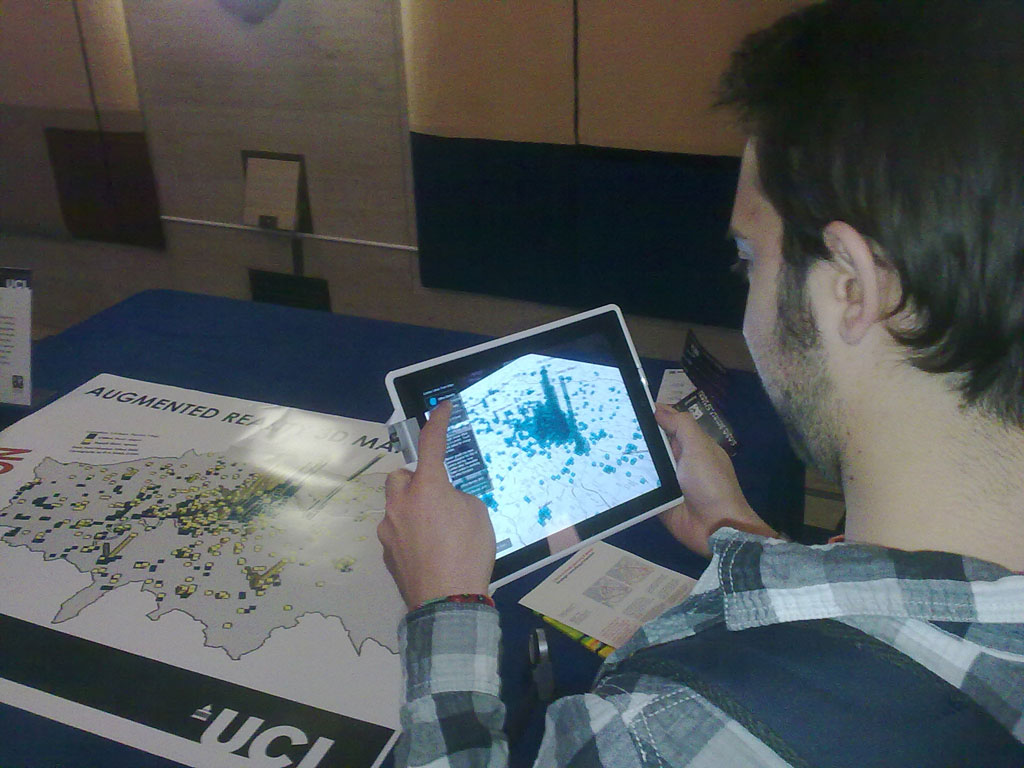
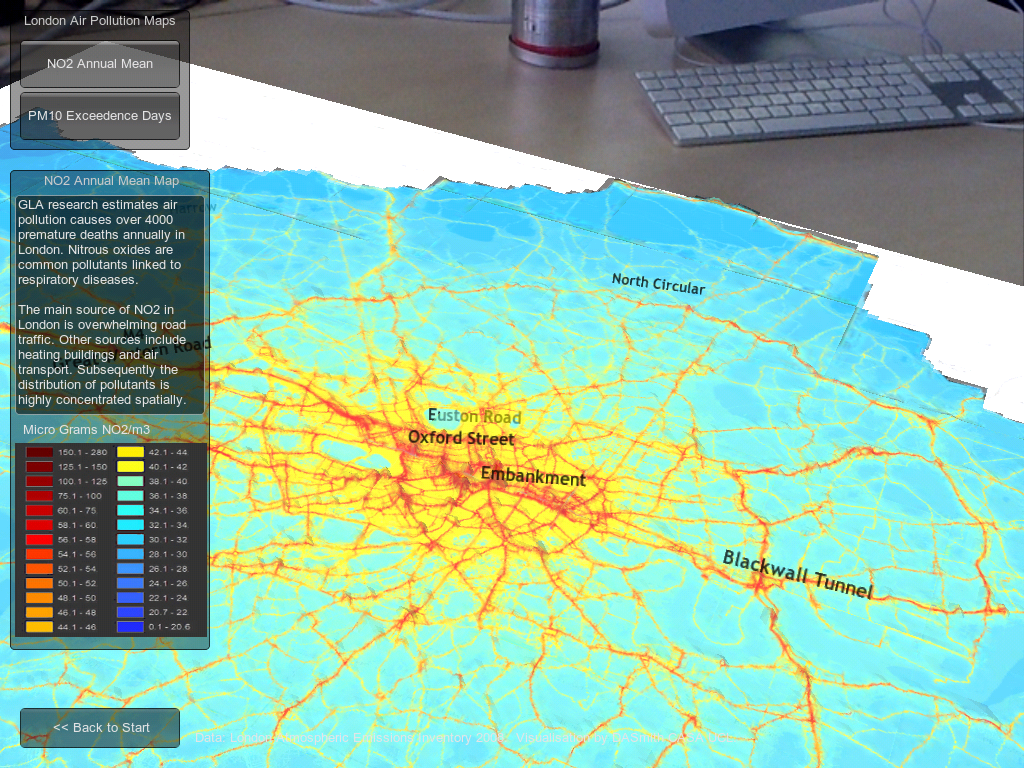
For my own exhibit I had a try at developing an augmented reality app to explore 3D urban data. The idea was to use iPads as the window into a 3D urban map of London, allowing the user to navigate around the virtual model to see different perspectives and focus on interesting parts of the data. Do we respond differently to data with a seemingly physical presence? Well this is one way to find out…

The app was developed in Unity using the Vuforia AR extension, and I was impressed with how accessible augmented reality technology has become using such tools. Firstly GIS data on urban form in London and air pollution was exported from ArcMap into Unity, and an interface to the data was developed. The core app without the AR capabilities can be viewed here (Unity web player required).

Next I followed the Vuforia iOS tutorials to add AR functionality. This approach uses a tracking image to position and scale the 3D model to the user’s viewpoint. Nice features of Vuforia include the ability to select your own tracking image, and that it can handle some occlusion of the image when the user moves to a particular part of the model, although a part of the tracking image must be in view of the camera at all times otherwise the model disappears from the user’s view. A large A0 poster was used as the tracking image, giving users greater flexibility in navigating the data.

The resulting app is very intuitive and delivered the desired ‘wow’ factor with many of the attendees at the conference. The AR aspect certainly encouraged users to explore the data, and identify patterns at different scales.

Adding more interactivity, animation and sorting out some issues with the target image (multiple smaller images would have worked better than one very large image) would all be nice for version 2. I’ll do a more detailed tutorial on the workflow developed later on if this is of interest.

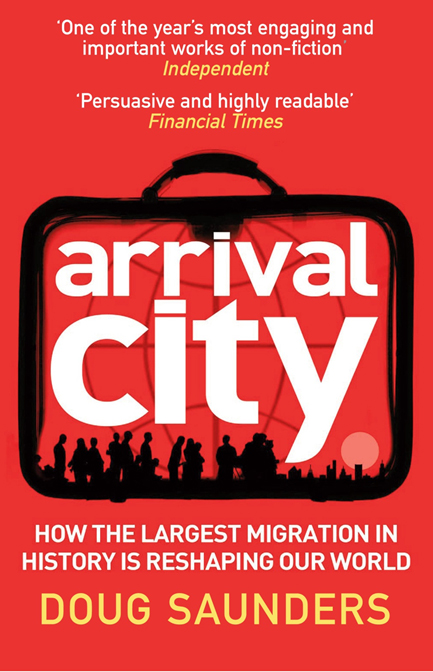
Arrival City by Doug Saunders

First published in 2010, I have only recently got round to reading Doug Saunders‘ excellent review of cities as the great engines of migration and, where successful, the route for the rural poor to achieve a better life and join the ranks of the middle classes. The ‘Arrival Cities’ are the urban districts (often termed slums) with concentrations of rural immigrants, with Saunders drawing on a wide set of case studies such as Tower Hamlets, Shenzen, Mumbai and Sao Paolo. In each case he tracks the lives of individuals making the leap of faith from villages, and how the relationship between city and village evolves.

Success for an arrival city, in terms of achieving social mobility, Saunders argues relates to the strength of local communities in arrival cities, and the ability for immigrants to start new small businesses, get jobs, and eventually gain citizenship. Saunders is critical of several examples from Western Europe where local jobs and ultimately citizenship are unobtainable as a result of policy and local circumstances. Policy is widely different between countries, with the most extreme example in China where millions of migrant workers are denied basic services and ability to own property outside of their local area. The physical form of districts can also be significant, where design prevents local shopping and business centres emerging, such as characterise the Paris banlieues. There’s a strong element of Jane Jacobs in Saunder’s argument, with his support for more organic urban districts and local businesses.

The urbanisation of billions of rural dwellers is surely the great urban story of the 21st century. This book provides an engaging overview of lessons learned from past and current arrival cities for how this great change in global geography can be facilitated.

The Evolving Business Geography of Greater London

I presented at the CASA Seminar Series yesterday on the topic of business centre specialisation in Greater London. The discussion drew on previous research into knowledge economy agglomeration and urban property markets.

The analysis showed how the diversity and restricted growth of West London underpins the current extremely high rents, whilst the greatly densified City of London faces oversupply with lower demand for financial services after the economic crises. The recent revival of centres in the City Fringe is based on creative industries and IT/new media, and it’s hoped similar recipes will work for future business centres at Kings Cross and Stratford.


The slides can be viewed here:

Sketching the City in Motion

Whilst social scientists approach cities from rational and technical perspectives, it’s often interesting to get some inspiration from the creative arts world. Linking with artists is an emerging trend at CASA, with collaboration with Edinburgh College of Art through the TalesofThings project, the use of common visualisation tools such as Processing, and recent events like James’s presentation at the Mapping London Life event.

A shared challenge for artists and scientists is exploring the dynamics of cities, from the buzz of daily street life to the slower demolition and creation of the built-environment. An artist I admire for capturing these flows through static images is Lucinda Rogers, whose works have recently gone online on a new website. Her illustrations of street life in New York and London use line thickness and blurred colour to give the impression of forms in motion- from pedestrians and cars on the street to cranes dancing around St Pauls.

Rogers tends to choose Inner City subjects just at the edge of the centre, where gentrification processes are in tension with the historic fabric and traditional industries- locations such as Shoreditch and mid-town Manhattan. In this sense New York and London have much in common.

Another interesting London illustration book recently released in London Unfurled. Matteo Pericoli has done a series of books of super-long panoramas, published concertina style in one very long folded sheet. For London he follows the Thames from Hammersmith to Greenwich, with the north bank on one side of the page and the south bank on the other. This works well as the Thames is a key way  to ‘learn’ the form of London, from historic panoramas to the present day. If a 20 metre long panorama is too big for your coffee table, London Unfurled also comes in ipad version.