
Geographers have long grappled with the complex and ever changing configurations of global urbanism. Many terms have been coined to describe new 20th and 21st century urban forms: conurbations (Geddes, 1915), multi-nuclei cities (Harris & Ultman, 1945), megalopolis (Gottman, 1961), world cities (Hall, 1966), desakota (McGee, 1991), fractal cities (Batty & Longley, 1994), network cities (Batten, 1995), postmetropolis (Soja, 2000), splintering urbanism (Graham & Marvin, 2001), polycentric mega-city regions (Hall & Pain, 2006)…
These concepts are diverse, coming from different perspectives with different methods and archetypal case studies. But there are shared themes: a focus on more diffuse and polycentric urban forms; recognition of city connections across multiple scales; and the rise of ever larger urban regions embedded in thicker global networks.
Representing and exploring the diversity of contemporary global urban forms is a challenge for cartographers. We often focus on mapping the amazing richness and diversity of dominant global cities like London and New York. Yet this is clearly a very biased lens from which to frame the vast majority of the globe, as researchers have noted. Postcolonial critiques like Robinson’s ordinary cities (2006) argue for a much more representative and cosmopolitan comparative urbanism. From a different angle, provocative research like Brenner’s (2014) ‘planetary urbanism‘ has critiqued the contentions of a universal urban age, arguing that urban/rural distinctions are no longer meaningful where capitalist networks reach to every corner of the globe.
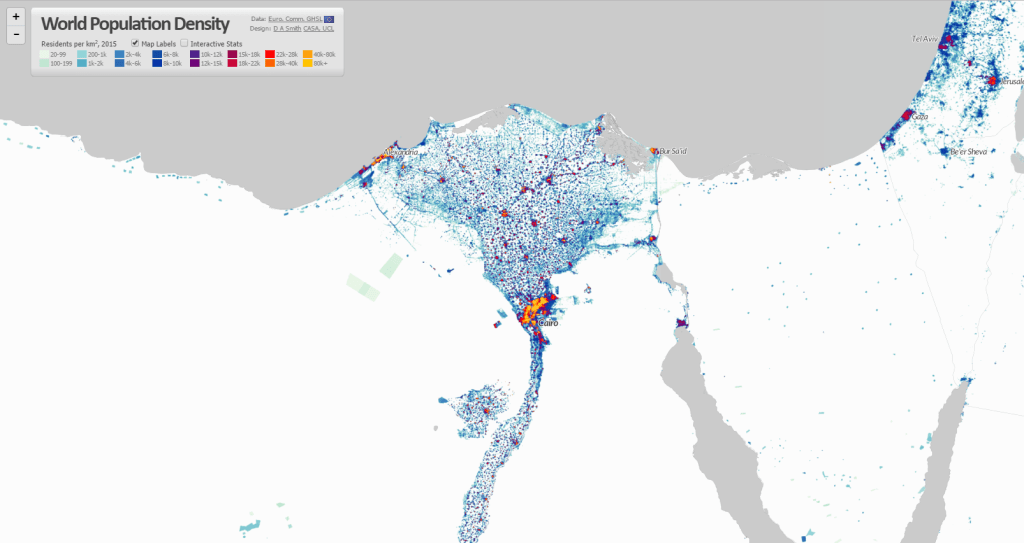
I recently released an interactive map of the new Global Human Settlement Layer (GHSL) produced by the European Commission JRC and CIESIN Columbia University. This dataset makes several advances towards an improved cartography of the diversity of global urbanism. Firstly it is truly global, representing all the world’s landmass and settlements at a higher level of detail, down to 250m. Secondly the population density and built-up layers are continuous: there are no inherent city boundaries or urban/rural definitions (the GHSL includes an additional layer with urban centres defined, but the user can ignore these and create their own boundaries from the underlying layers). Thirdly the dataset is a time-series, including 1975, 1990, 2000 and 2015. Finally the data layers and the methods used to create them are fully open.
Diversity and Structure of Global Urban Constellations
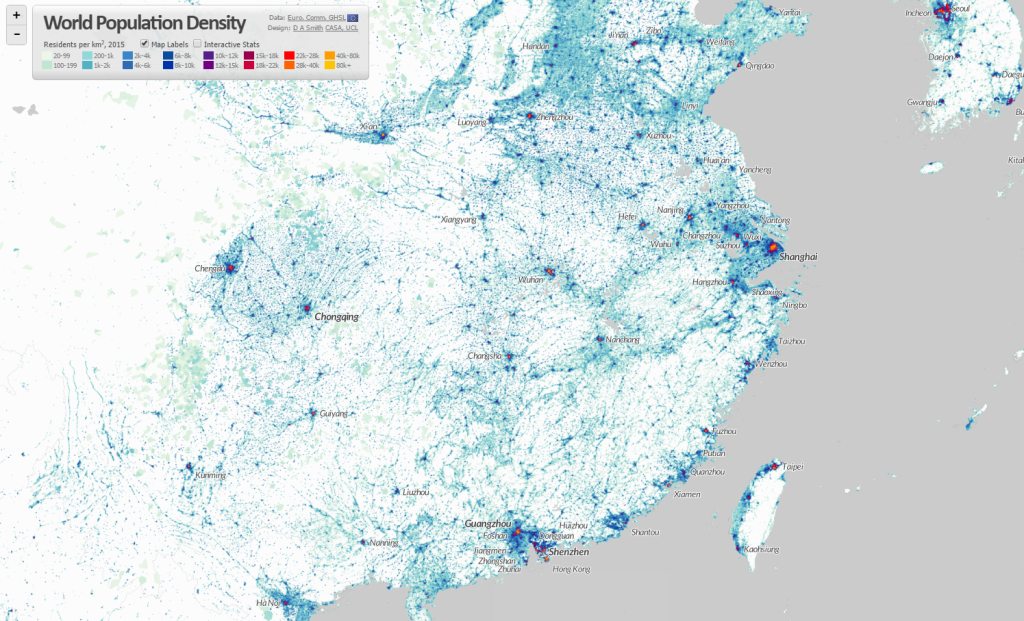
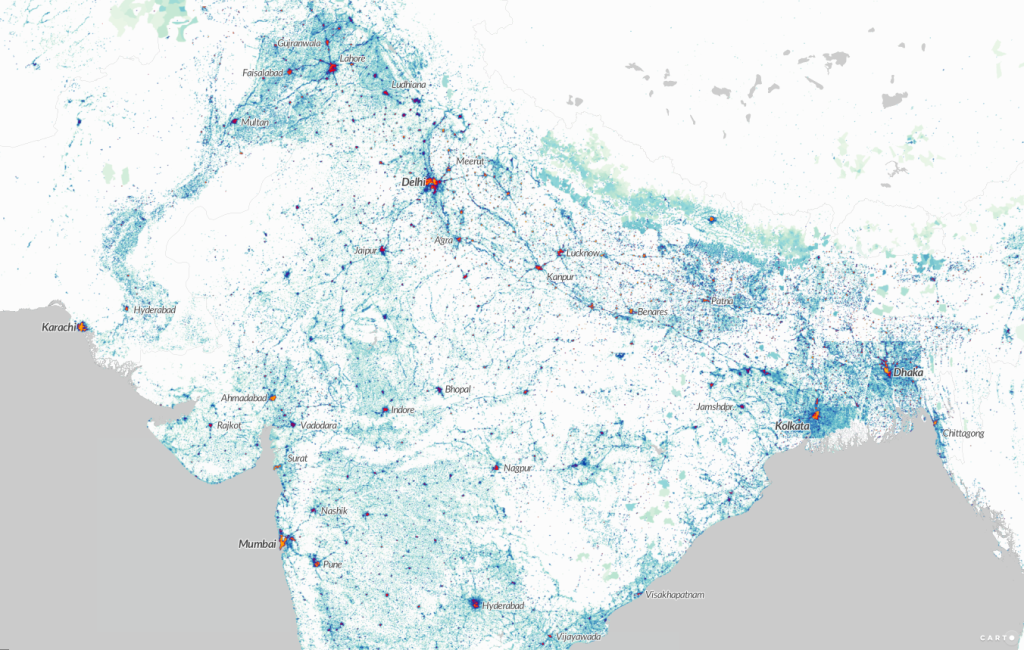
The complexity and scale of the GHSL data is both beautiful and beguiling. In China and India there are continuous landscapes of connected urban settlements with hundreds of millions of people, scattered across many thousands of square kilometres. The cartographic appearance of these regions is like constellations of stars coalescing in vast nebulae of diffuse population. Densities of South and South-East Asian towns and small settlements in semi-rural regions exceed many major cities in Europe and North America. These are complex evolving landscapes at a scale and extent unprecedented in the history of urbanism.
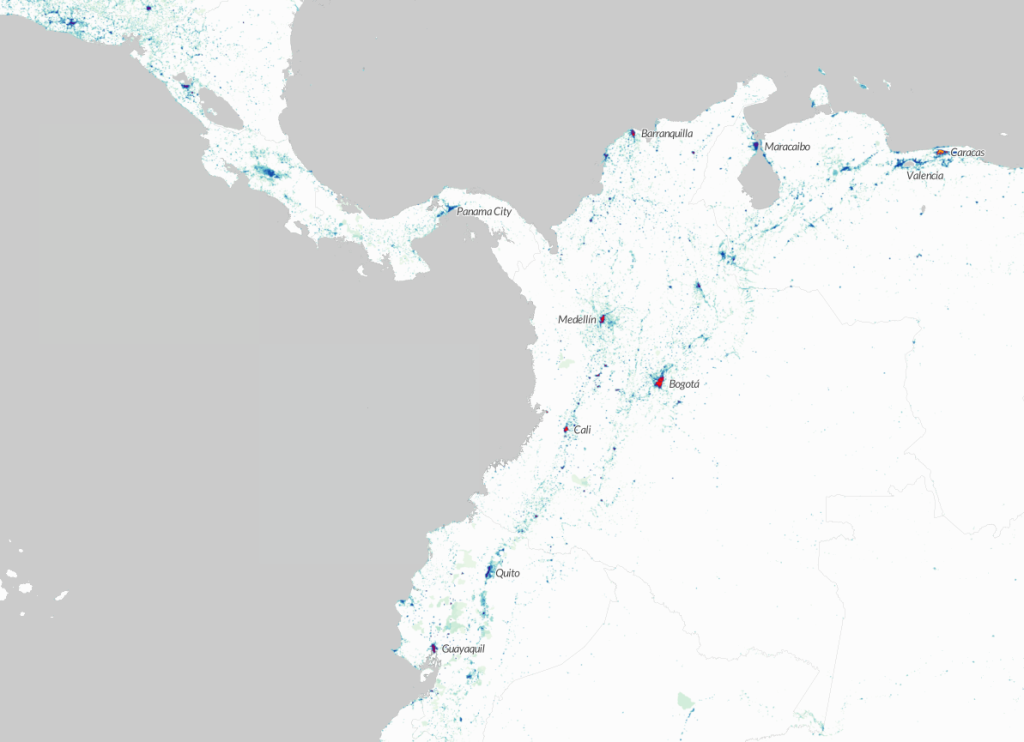
Similarly there are unique trends in other major regions of urbanisation such as Latin America. Here major centres are very high density, but the extent of diffuse rural populations is far less prevalent. As a result countries like Colombia and Brazil have some of the highest urban population densities in the world.
The recognition of this global diversity does not mean abandoning global theories of urbanism. Even amongst such complexity and diversity, we can still observe shared spatial patterns and connections. Clearly we are observing landscapes heavily influenced by our current era of intense globalisation, as well as retaining inherited patterns from previous eras. Spatial logics of globalisation are apparent across the globe, though differentiated between regions, economies and societies.
The pull of coastal areas for global trade is an obvious spatial pattern. The importance of port cities is also applicable to historic periods of ancient civilisations, and indeed to globalisation in the 18th and 19th centuries. But the difference in the 20th and 21st centuries appears to be the more intensive links between major ports and global megaregions of production and manufacturing. We can observe this in the huge megaregions of China: the Pearl River Delta and Yangtze Delta (both with around 50m population depending on where the boundary is drawn), which are China’s leading manufacturing centres.
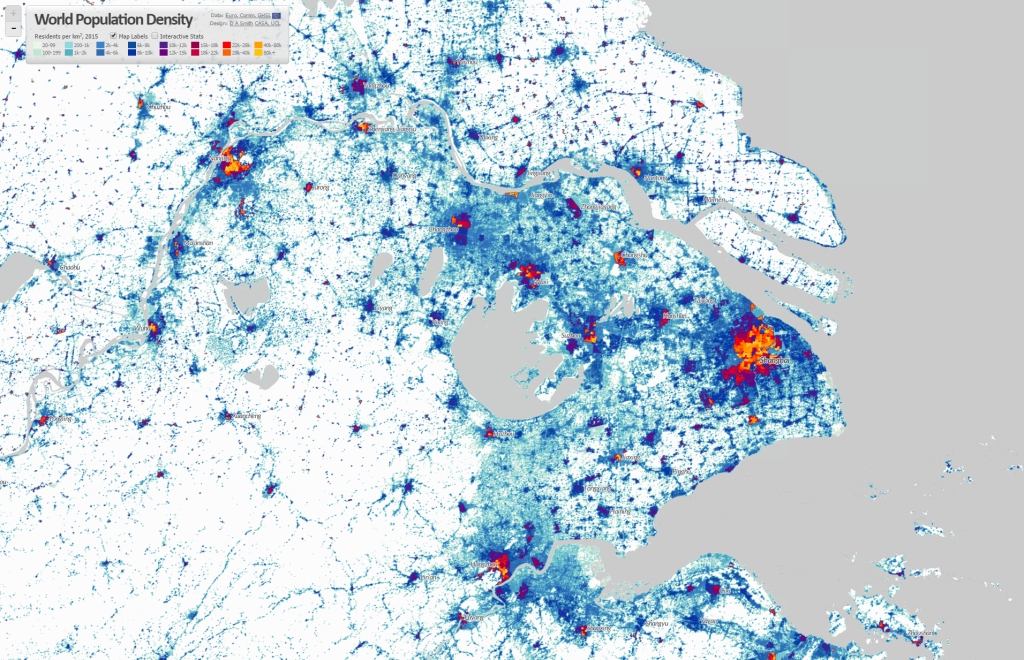
It also applies to Europe, with the higher density spine of the ‘blue banana’ linking low country ports to manufacturing centres in western Germany and north-eastern France, and more loosely to south-east England and northern Italy. As well as the manufacturing roles, it is clear that most major global financial centres are closely linked to megaregions, either at their core (e.g. Shanghai, New York, Tokyo) or within a couple of hours travel (e.g. Hong Kong, London, Paris). These centres provide the capital and business services that embed megaregions in global networks.
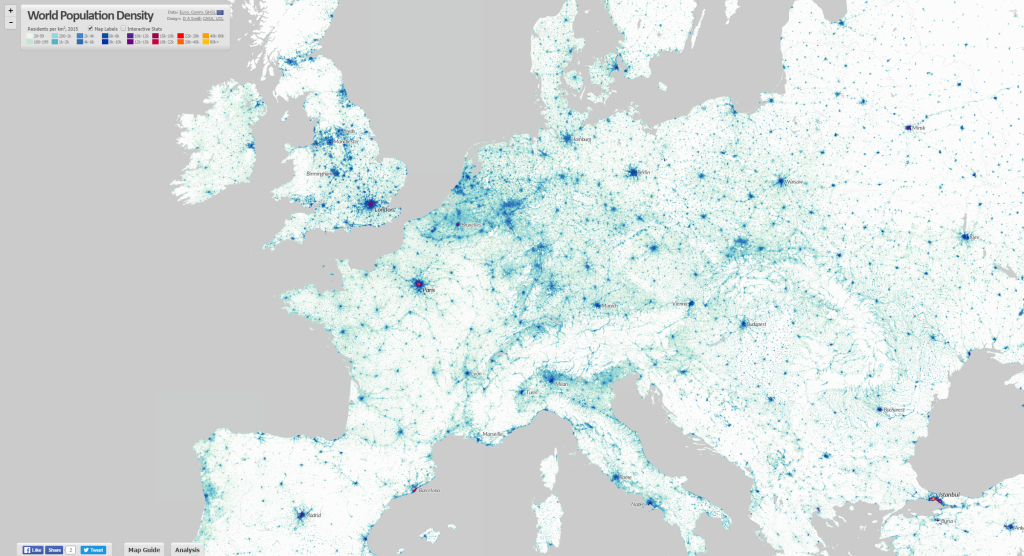
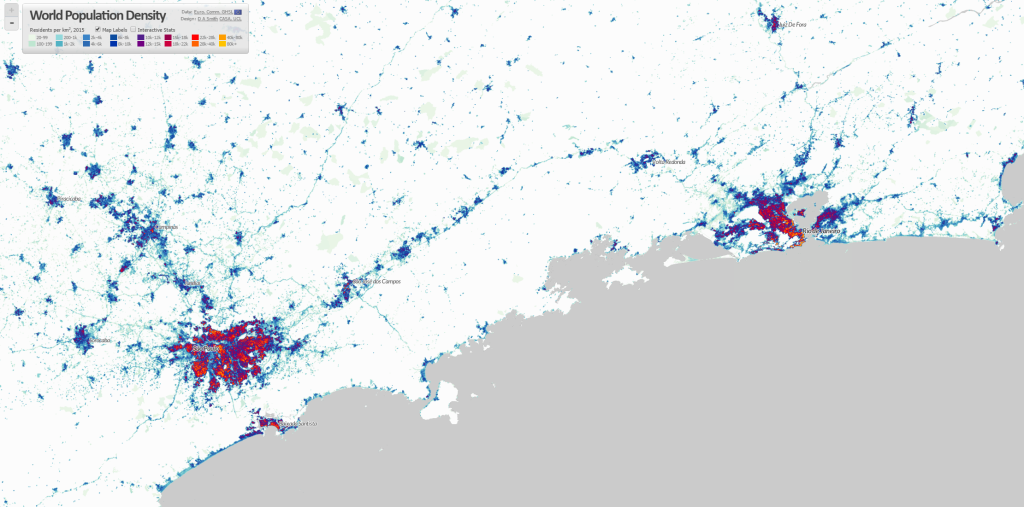
The importance of ports is also evident in South Asia. Port cities in South Asia are amongst the fastest growing in the world, such as Dhaka, Mumbai, Karachi, Kolkata and Chennai. But megaregions here appear as yet to be less extensive and well connected. Latin American cities are even more spatially separated and precisely defined in density terms, though there are signs of increasing connections between for example the two great Brazilian metropolises, Sao Paulo and Rio de Janeiro, and in the north between Venezuelan and Colombian port cities.
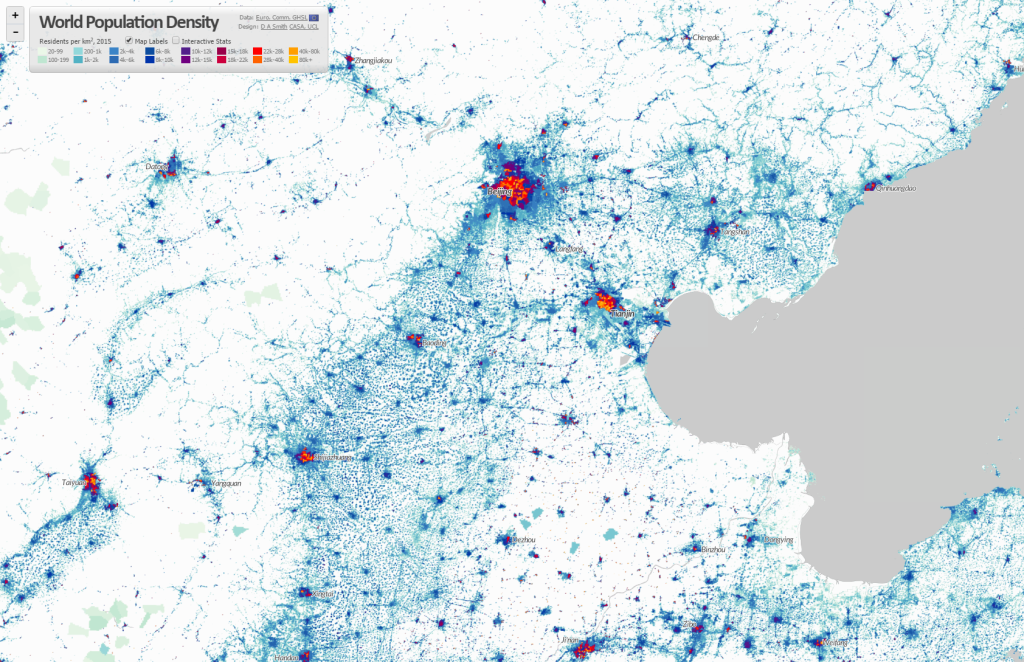
Another fascinating pattern relates to large previously rural areas of population in developing countries that are urbanising in more diffuse and bottom-up patterns. McGee used the term desakota (village-city) to describe patterns of disperse rural development in Java Indonesia. There appear to be similar patterns emerging across regions of China and India, including many areas of the vast Ganges plain, and along the great rivers of China. One of most striking features in China is the concentration of semi-rural and urban populations radiating south-west from Beijing towards Shijiazhuang and then south towards Zhengzhou (this follows one of China’s oldest rail routes, built 1903 and is nearly 600km long).
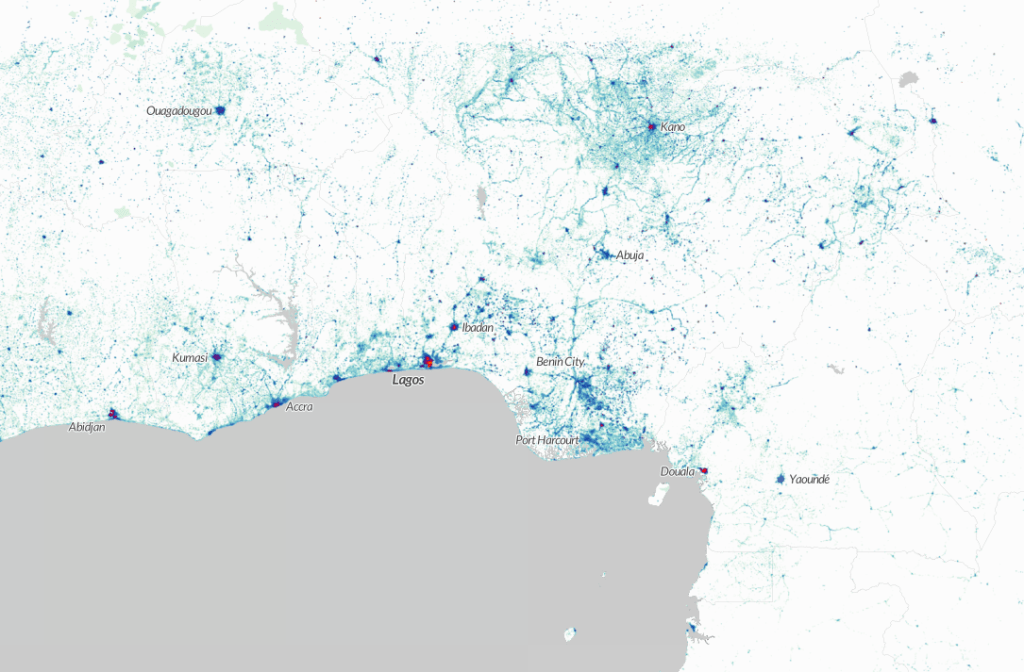
There are several areas of sub-Saharan Africa where desakota-like patterns seem to be apparent. The west coast around Nigeria and Ghana is one such area. Another is the many developments around Lake Victoria in Uganda, Kenya and Tanzania. Clearly the cultural and geographical diversity is very high in these regions, and my own knowledge of these countries is very limited. But the similar density patterns is still of interest.
Population and Density Statistics
The World Population Density map includes density statistics at national and city scales, with population totals classified into density groups (turn on the Interactive Statistics button at the top left). These help to identify differences in patterns of settlement, and how city densities relate to national distributions.
If we view the world’s highest density cities, we can see the clear links to the above discussion of urbanisation in South Asia and East Asia, and major global port cities. Note however there are many issues with defining and measuring density, which need to be borne in mind when interpreting such statistics. These are measures of residential density, and results will likely be affected by the scale and accuracy of the underlying census data. It would also be better statistically to measure peaks as the 95th or 99th percentile to prevent a single square km cell skewing the results, as there are some outliers in the results.
Highest peak density cities GHSL 2015 1km scale-
| City Name | Country | Peak Density (000s pp/km2) | Mean Density (000s pp/km2) | Population (millions) |
| Xiamen-Longhai | China | 330.5 | 6.3 | 4.75 |
| Peshawar | Pakistan | 228.9 | 3.3 | 7.54 |
| Dhaka | Bangladesh | 197.8 | 9.1 | 24.83 |
| Daegu | South Korea | 189.4 | 8.5 | 2.58 |
| Maunath Bhanjan | India | 177 | 38.4 | 0.77 |
| Cairo | Egypt | 175.5 | 5.1 | 37.84 |
| Kolkata | India | 173.5 | 5.8 | 26.87 |
| Baharampur | India | 166.1 | 38 | 1.25 |
| Bahawalpur | Pakistan | 136.9 | 29.6 | 1.06 |
| Xi’an | China | 135.4 | 7.1 | 6.04 |
| Kabul | Afghanistan | 132.7 | 18 | 4.36 |
| Nanjing | China | 130.1 | 6.7 | 6.6 |
| Guangzhou-Shenzhen | China | 128.3 | 5.6 | 46.04 |
| Hangzhou-Shaoxing | China | 127.6 | 4.4 | 7.81 |
| Manila | Philippines | 127 | 9.9 | 22.45 |
We can also consider the highest population city-regions based on the GHSL urban centre boundaries. These are defined as continuous built-up areas, with polycentric regions linked into single cities. This leads to quite different results for world’s largest cities, with the Pearl River Delta measured as the world’s biggest urban agglomeration at 46 million (and that’s not including Hong Kong or Macao). It is interesting to compare this to results from the UN World Urbanisation Prospects data, which keeps these regions as separate cities and identifies Tokyo as the world’s largest city-region.
Highest population urban centres GHSL 2015 1km scale-
| City Name | Country | Peak Density (000s pp/km2) | Mean Density (000s pp/km2) | Population (millions) |
| Guangzhou-Shenzhen | China | 128.3 | 5.6 | 46.04 |
| Cairo | Egypt | 175.5 | 5.1 | 37.84 |
| Jakarta | Indonesia | 20.4 | 6.1 | 36.4 |
| Tokyo | Japan | 23 | 6.2 | 33.74 |
| Delhi | India | 68 | 11.1 | 27.63 |
| Kolkata | India | 173.5 | 5.8 | 26.87 |
| Dhaka | Bangladesh | 197.8 | 9.1 | 24.83 |
| Shanghai | China | 104.4 | 7.5 | 24.67 |
| Mumbai | India | 49.5 | 13.9 | 23.41 |
| Manila | Philippines | 127 | 9.9 | 22.45 |
| Seoul | South Korea | 103.1 | 8.8 | 22.13 |
| Mexico City | Mexico | 42 | 8.2 | 20.09 |
| São Paulo | Brazil | 38.7 | 8.9 | 20.02 |
| Beijing | China | 84.8 | 6.6 | 19.9 |
| Osaka | Japan | 13.4 | 5 | 16.53 |
Future Cartography of Global Urbanism
Population density is clearly a very useful base from which to understand urbanisation and patterns of settlement. But we can also see its limitations too in the World Density Map if urbanisation is viewed only in terms of density. Many US city-regions are very low density, much lower than semi-rural parts of Asia and Africa, but these US cities are amongst the most affluent and highly urbanised areas of the globe.
Clearly a more comprehensive cartography of global urbanism would combine population density with measurements of development and economic activity, and the flows of people, goods, energy and information that describe the dynamics of how cities and networks function. The development of open global datasets like the GHSL will greatly help in these endeavours.
Another important issue is improving the sophistication of spatial statistics to include multiple urban boundaries and limit Modifiable Areal Unit effects. This would be possible with the GHSL dataset, and I have tried including national and city statistics, but clearly MAUP effects remain when using fixed city boundaries. Something along the lines of my colleagues’ research testing statistics for multiple boundaries simultaneously and showing their influence would be a good avenue to explore.




 CityGeographics