A Tale of Tech City: the future of Inner East London’s Digital Economy

Earlier this month Demos published a fascinating report on the hot topic of London’s “Tech City” cluster, which has been promoted by the government as a key growth pole for the UK. The report authors Max Nathan, Emma Vandore and Rob Whitehead, put the Inner East London cluster in the context of similar phenomena in New York and Berlin; and get their hands dirty with some in-depth data analysis and face-to-face interviews of entrepreneurs. Policy recommendations are then made for the best way forward.

There have been some cool efforts at mapping the Silicon Roundabout Shoreditch/Old Street cluster from Wired UK, and from Tech City Map using social networking connections. A more traditional robust approach was taken in this report of using the various business survey datasets to measure firms and their activities. The scale of the cluster (defined more widely to include Clerkenwell, Shoreditch and Hoxton) was found to be larger than previously thought, at around 3,200 digital economy firms and 48,000 jobs, with these industries becoming increasingly important for the London economy.

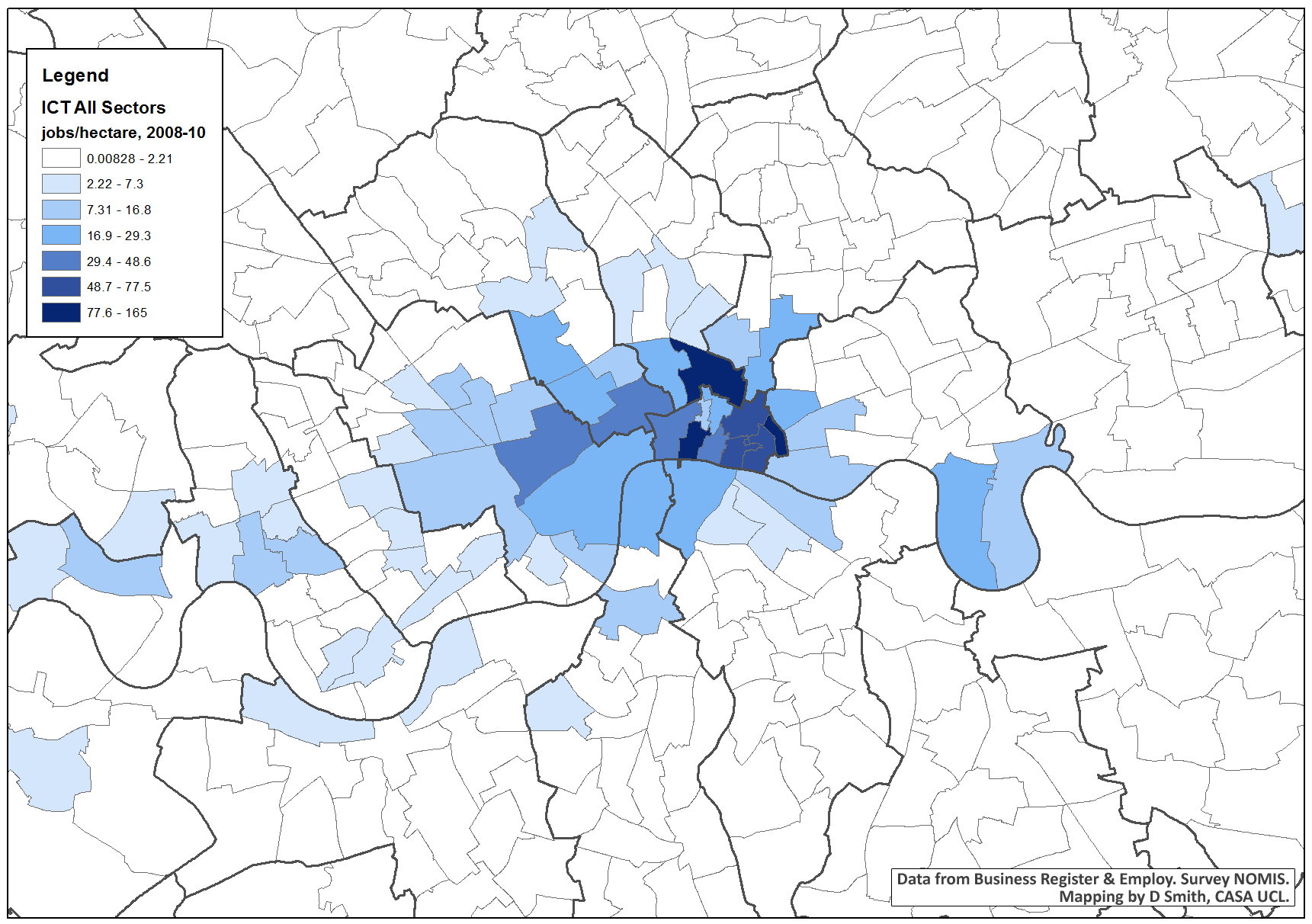
I got involved with the project doing some density mapping of the core industries that make up the cluster: ICT firms and creative industry firms. The key message that comes from such mapping is that the cluster is embedded in a digital-creative corridor stretching from the West-End and Soho through Clerkenwell and on to Shoreditch.
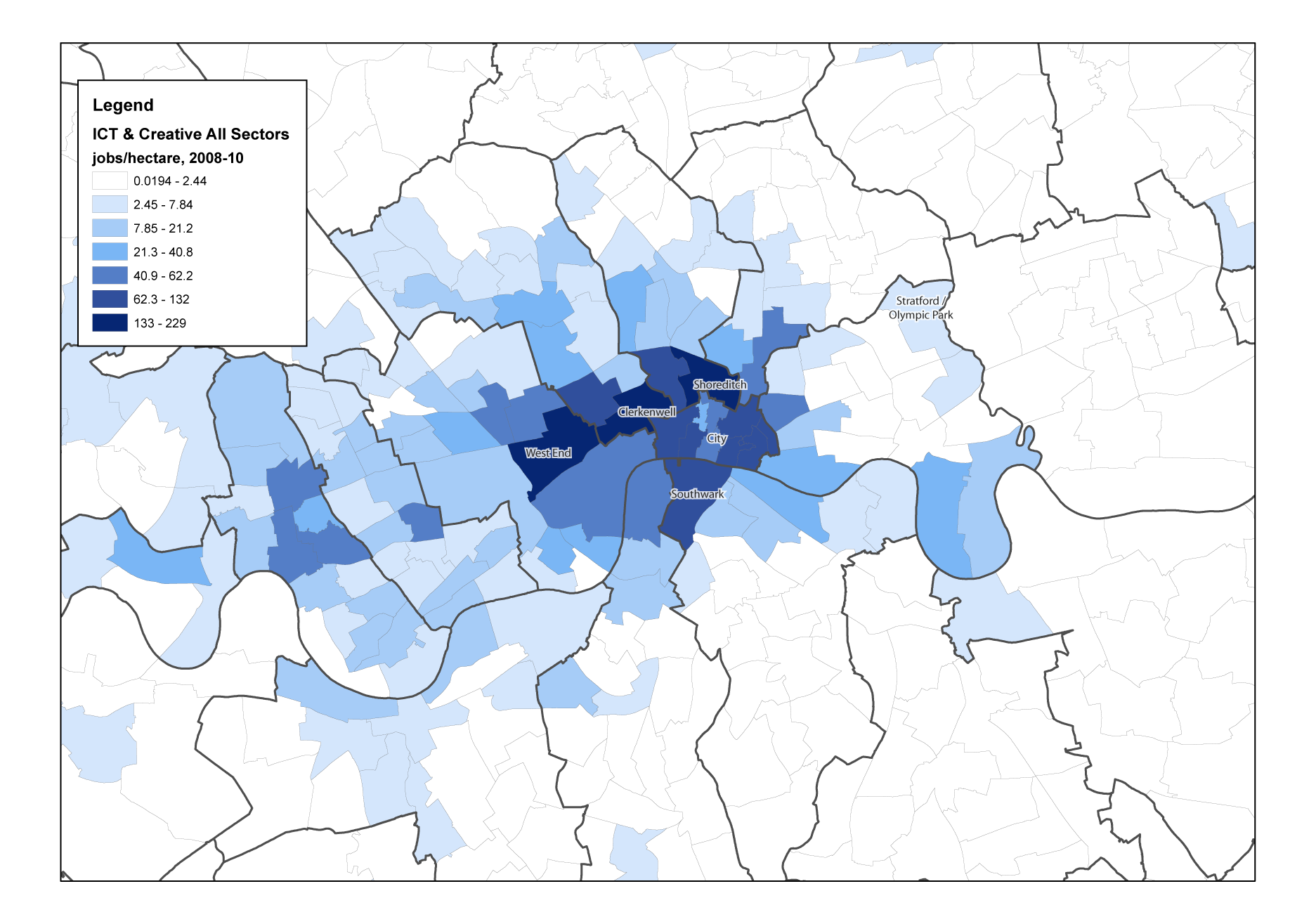
From a spatial perspective, the cluster is about the Jane Jacobs type urban diversity fusion of IT and creative industries, very similar to Silicon Alley in NYC. High profile success stories like LastFM (music, digital broadcasting and social networking crossover) and Unruly Media (advertising, social network and analytics crossover) are prime examples of this integration. This tech-creative fusion clearly distinguishes the Inner London cluster from the IT software/hardware concentrations you get in Silicon Valley, or in the “Western Wedge” around Heathrow.

A high profile policy objective from the UK government has been to link the Inner East London cluster to future opportunities at the Olympic Park. The Demos report convincingly argues that the focus should rather be on the current cluster, enhancing funding opportunities, skills and growing new businesses. Moving to the Olympic Park is problematic in terms of it lacking the history, creativity and ‘vibe’ of the current cluster. The absence of creative and IT firms around Stratford is apparent in the above maps. Opportunities in the Olympic Park are more likely to suit larger established IT and engineering firms attracted to new high-spec offices.

That’s not to say the Olympic Park can’t have a role however. The firm interviews in the Demos report identified the lack of skilled workers being a big issue, at all levels including graduates:

There just aren’t enough computer scientists in the uk. And we need computer scientists, we don’t need – what do they call it – ICT trained people. We need real computer scientists who do software engineering and programming. No education coupled with visa restrictions is not a particularly good combination.

So apart from lifting the current counter-productive visa restrictions in the UK, there’s a clear role for universities in training more computer scientists with the right skills to succeed in these growing industries. This is what London universities are now in the process of doing at the Olympic Park, with new campuses planned and initiatives such as the UCL-Imperial smart cities institute in the pipeline. Your very own CASA is already involved in training graduates with smart cities skills. Smart Cities industries can themselves be viewed as a built environment-engineering-ICT fusion, likely complimentary to creative industry clusters.



Visualising Flows 2: the Global CO2 Emissions Supply Chain

GlobalCarbonFlows_web

Every so often you come across a dataset that really amazes you in its richness and ability to change perspectives on understanding the world. One such dataset has been produced by academics at Stanford and Oslo tracing the global supply chain of CO2 emissions.

Traditionally emissions are attributed to countries depending on where fuels are burned- the point of production. This approach puts big industrial polluters like China at the top of the emissions pile. Yet globalisation means that we are linked into an increasingly complex web of trade that challenges a production-based understanding of emissions. A quarter of fossil fuel CO2 emissions can be considered as being embedded in manufactured goods that are consumed away from the point of production.

To address this issue Davis, Peters & Caldeira have created a database charting the global supply chain of CO2 emissions from extraction to production and finally to consumption. The database covers coal, oil, gas and secondary fuels traded by 58 industrial sectors in 112 countries for the year 2004. Even better, the entire database is available online.

Maps of the major carbon transfers included in the paper highlight firstly the massive flows from the energy rich Middle East and Russia, and secondly how production emissions from industrial countries such as China are ultimately driven by consumption in the affluent core of USA, Europe and Japan.

Davisetal_FlowMap

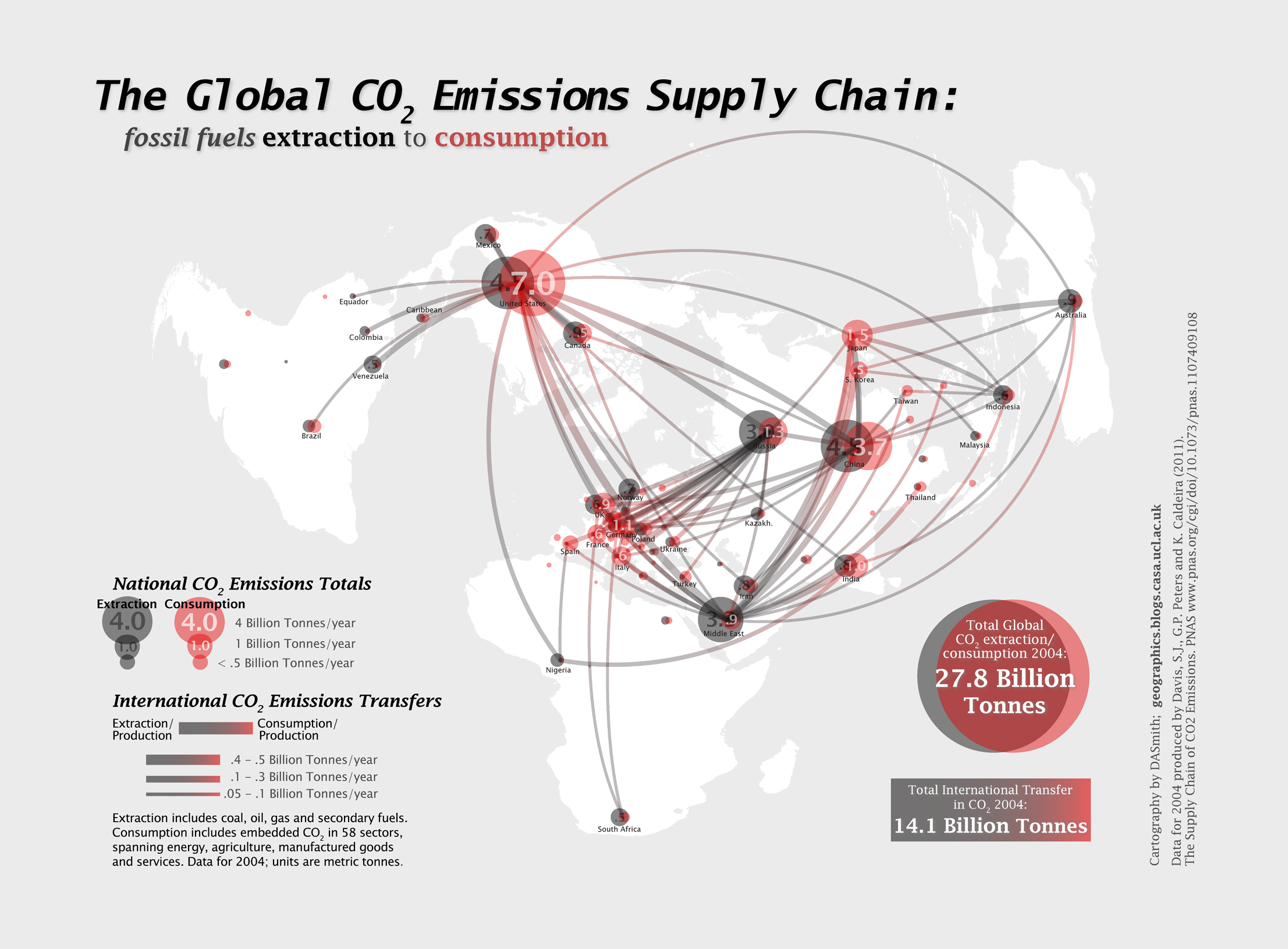
Being a mapping type, I feel that the flow maps in the paper miss out much of the amazing detail in the dataset, such as extraction to consumption flows within countries (half of all emissions). So I decided to put my visualisation skills to the test…

First up I produced a proportional bubble map of extraction and production, giving a good sense of the relative scale between countries. Economies with high levels of both extraction and consumption (e.g. USA and China) exploit their own energy resources and have large emission flows within their national boundaries. Other large consuming nations that lack energy resources (e.g. the EU,  Japan and South Korea) must import them.

GlobalCarbonBubble_web

Next I mapped the transfers of CO2 embedded in trade flows, using the same black-red colour scheme to indicate flow direction. While the visualisation is not as straightforward as the simpler flow map above, it gives a strong sense of the amazing complexity in global trade relationships and highlights clear patterns and structures.

GlobalCarbonFlows_web

Black lines emanate from the major energy exporters of the Middle East and Russia. Indeed the degree to which all of Europe is dependent on Russian energy is highly alarming. Major industrial countries act as intermediaries, both importing and exporting emissions. For instance China and Japan import energy and materials from the Middle East, Indonesia and Australia, then export manufactured products to the USA and Europe. The USA is top predator in the emissions food chain, spectacularly drawing in goods and resources from every corner of the globe and racking up over 25% of global emissions by consumption.

The data is for 2004, so some current trends like the strong growth of South America, continued growth of China and the strengthening relationships between China and Africa are not fully captured. Hopefully an update will come in the not too distant future.

On the cartography side, I went for the Azimuthal Equidistant projection to emphasise the close North America-Europe-Asia links. This projection is recognisable as the basis of the United Nations logo. Here however it is global capitalism and environmental exploitation drawing the world together like some kind of tightening noose. After another empty environmental conference at Rio+20, burning billions of tonnes of fossil fuels is set to remain a defining characteristic of our age.